Quran Rules of Tajweed: Complete Guide for Beginners
Introduction Many people can read Arabic letters but still feel unsure when reciting the Quran. They may recognize the words, yet they worry about pronunciation, stopping incorrectly, or missing important…

Introduction
Many people can read Arabic letters but still feel unsure when reciting the Quran. They may recognize the words, yet they worry about pronunciation, stopping incorrectly, or missing important sounds. This is where quran rules of tajweed help.
Tajweed gives every Quran letter its correct pronunciation and helps readers recite with accuracy. It is not only about making the recitation sound beautiful. It also helps protect the meaning of Quranic words by avoiding pronunciation mistakes.
The first challenge for many beginners is knowing where to start. Terms like Izhar, Idgham, Ikhfa, Madd, and Qalqalah can feel confusing at first. However, when these rules are organized step by step, learning becomes much easier.
This guide explains the main Tajweed rules in a simple way. It covers the foundation of Tajweed, common rules, pronunciation concepts, and practical steps that help beginners build confidence.
What is Tajweed and Why Does It Matter?
Tajweed (تجويد) means to improve, perfect, or beautify. In Quran recitation, it refers to the set of rules that help a person pronounce each letter correctly and recite the Quran properly.
Some pronunciation mistakes in Quran recitation can affect the accuracy of a word or, in some cases, its meaning. For this reason, learning correct letter sounds, articulation, and the appropriate rules of recitation is important for Quran readers.
Tajweed focuses on giving each letter:
- Its correct pronunciation
- Its proper articulation point
- Its required characteristics
- Its correct timing during recitation
The goal is not simply to read faster. The goal is to read with care and accuracy.
Meaning of Tajweed
The Arabic language contains sounds that may not exist in English. Because of this, many English-speaking Quran learners need extra attention when learning certain letters and sounds.
Tajweed helps learners understand:
- Where Arabic letters come from
- How letters should sound
- When sounds should merge
- When sounds should be clear
- How long vowels should continue
A learner does not need to master everything at once. Building a strong foundation makes the later rules easier to understand.
Importance of Learning Tajweed
Learning Tajweed helps prevent common recitation mistakes. A reader may accidentally change a letter sound, miss an elongation, or stop at an unsuitable place.
For example, similar Arabic letters can have different meanings. Correct pronunciation helps keep Quran recitation accurate.
Tajweed also improves confidence. Many beginners hesitate because they are unsure if they are reading correctly. Understanding the rules gives them a clearer direction.
Benefits of Tajweed
Tajweed brings several benefits to Quran learners.
It helps readers:
- Improve pronunciation
- Recognize common recitation rules
- Read Quran more carefully
- Build confidence while practicing
- Develop a stronger connection with Quran recitation
Learning Tajweed is also a gradual process. Listening and practice are important because recitation is a skill that develops through hearing and repeating correct sounds.
Learning Tajweed
Tajweed is best learned with guidance because many pronunciation mistakes are difficult to notice by yourself. A teacher can help identify areas that need improvement. However, personal practice is also valuable.Listening to skilled Quran reciters and comparing pronunciation can help learners understand Tajweed concepts and correct sounds. For learners who want structured support, an online Tajweed course can provide organized lessons and guidance while practicing from home.
Quran Rules of Tajweed: Main Rules Explained
The main Tajweed rules are easier to understand when divided into groups. Instead of memorizing everything together, beginners can learn each category one by one.
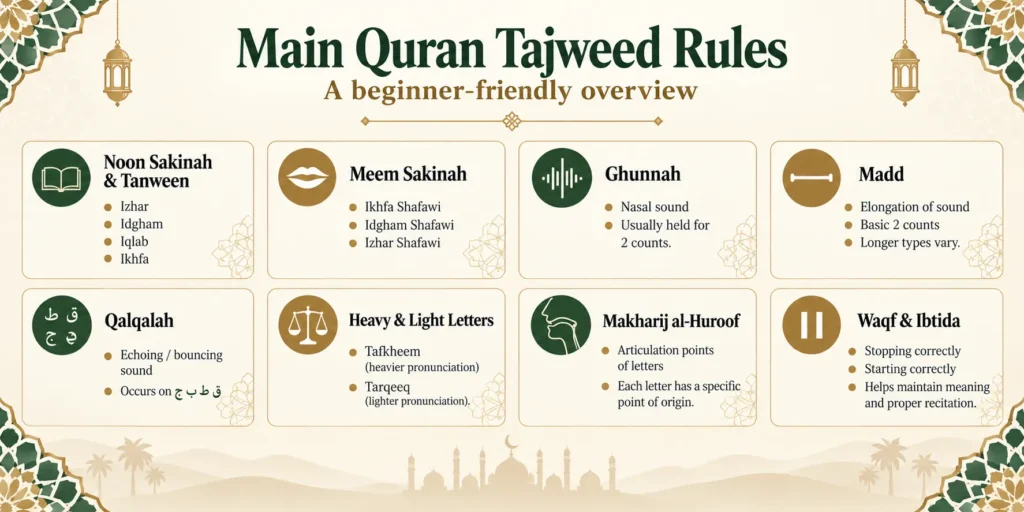
| Tajweed Rule | Main Purpose |
| Noon Sakinah and Tanween | Correct pronunciation when noon or tanween appears |
| Meem Sakinah | Correct pronunciation of meem with sukoon |
| Ghunnah | Proper nasal sound |
| Madd | Correct stretching of sounds |
| Qalqalah | Correct echoing sound |
| Heavy and Light Letters | Correct letter weight |
| Makharij Al-Huroof | Correct articulation points |
| Waqf and Ibtida | Correct stopping and starting |
Noon Sakinah and Tanween Rules
Noon Sakinah (نْ) and Tanween (ً ٍ ٌ) are among the most common Tajweed rules because they appear frequently in Quran recitation.
These rules explain how the noon sound changes depending on the letter that comes after it.
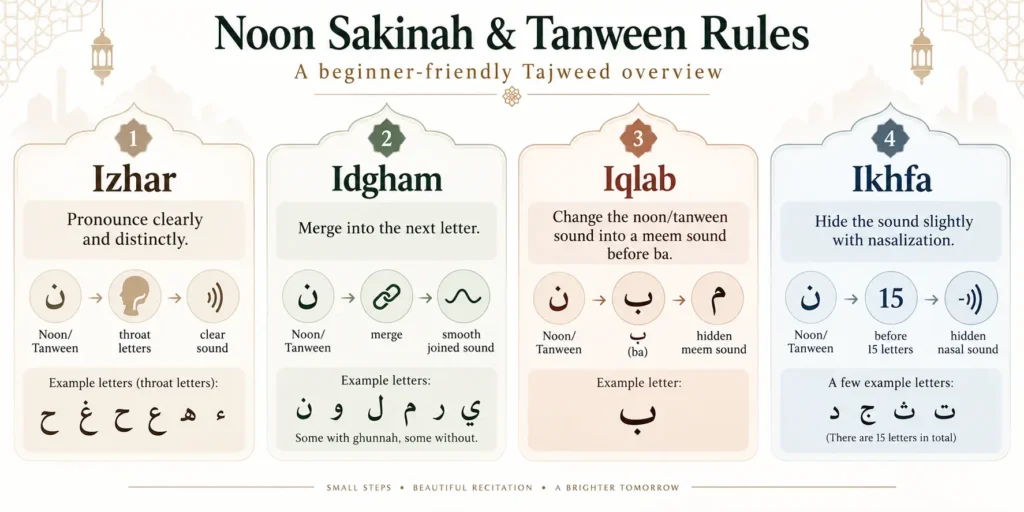
There are four main rules:
- Izhar
- Idgham
- Iqlab
- Ikhfa
Izhar (Clear Pronunciation)
Izhar means making the sound clear.
When Noon Sakinah or Tanween comes before one of the throat letters, the noon sound is pronounced clearly without hiding or merging.
The Izhar letters are:
ء ه ع ح غ خ
The reader should pronounce the noon normally and clearly.
Idgham (Merging)
Idgham means merging one sound into another.
When Noon Sakinah or Tanween comes before specific letters, the noon sound joins with the following letter.
Idgham has two types:
Idgham With Ghunnah
This happens with:
ي ن م و
The merged sound includes a nasal sound.
Idgham Without Ghunnah
This happens with:
ل ر
The noon sound merges without the nasal sound.
Iqlab (Conversion)
Iqlab means changing.
When Noon Sakinah or Tanween comes before the letter ب, the noon sound changes into a meem-like sound with ghunnah.
This rule requires careful pronunciation because the reader should not pronounce the original noon sound clearly.
Ikhfa (Concealment)
Ikhfa means hiding.
In this rule, the noon sound is partially hidden while keeping the ghunnah sound.
The Ikhfa letters are: ت ث ج د ذ ز س ش ص ض ط ظ ف ق ك.
The sound is between clear pronunciation and complete merging.
Meem Sakinah Rules (أحكام الميم الساكنة)
Meem Sakinah refers to the letter meem (مْ) with a sukoon. These rules explain how to pronounce meem when another letter comes after it.
Compared with Noon Sakinah and Tanween, Meem Sakinah has fewer cases. It has three main rules:
- Idgham Shafawi
- Ikhfa Shafawi
- Izhar Shafawi
Idgham Shafawi (Labial Merging)
Idgham Shafawi happens when a Meem Sakinah is followed by another meem.
In this case, the two meem sounds merge together, and the reader applies ghunnah.
The sound should not be rushed. The lips come together naturally while producing the merged meem sound.
Ikhfa Shafawi (Labial Concealment)
Ikhfa Shafawi occurs when Meem Sakinah comes before the letter ب.
The meem sound is partially hidden while maintaining the nasal sound.
This rule requires attention because both meem and ba involve the lips. Beginners often need practice to separate the sounds correctly.
Izhar Shafawi (Labial Clarity)
Izhar Shafawi applies when Meem Sakinah is followed by any letter except meem and ba.
The meem is pronounced clearly without merging or hiding.
The lips should close properly for meem before moving to the next letter.
Noon and Meem Mushaddad
A shaddah (ّ) changes how a letter is pronounced. When Noon (ن) or Meem (م) carries a shaddah, the reader applies ghunnah.
The sound is held with a nasal quality.
Examples include:
- إِنَّ
- ثُمَّ
The key point is to focus on the ghunnah sound rather than extending the entire letter.
Ghunnah (Nasalization)
Ghunnah is a nasal sound that comes through the nose during certain Tajweed rules.
It commonly appears with:
- Noon with shaddah
- Meem with shaddah
- Idgham with ghunnah
- Ikhfa
- Iqlab
- Ikhfa Shafawi
For beginners, ghunnah can feel difficult because it is not only about knowing the rule. The reader must recognize the sound while reciting.
A useful way to understand it is to notice the nasal vibration when producing the sound correctly.
Madd Rules (أحكام المد) — Prolongation
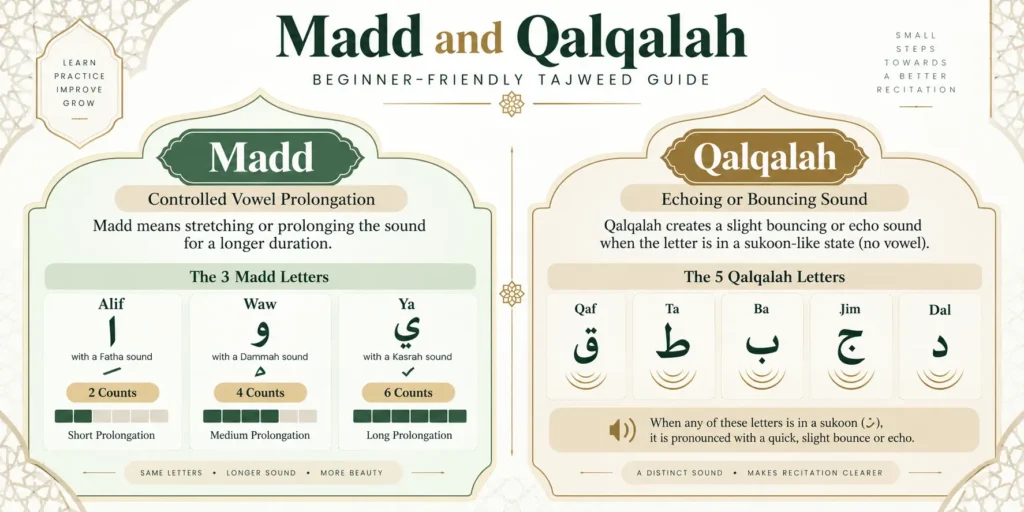
Madd means stretching a vowel sound. The length of the stretch depends on the rule and what follows the Madd letter.
The three Madd letters are Alif (ا), Waw (و), and Ya (ي). These letters function as Madd letters when the required vowel conditions are present.
Understanding Madd is essential because incorrect stretching can affect the flow of Quran recitation.
Madd Tabee’i (Natural Prolongation)
Madd Tabee’i is the basic Madd rule.
When a Madd letter is not followed by Hamzah or Sukoon, the sound is stretched naturally.
This is the foundation for understanding other Madd rules.
Madd Muttasil (Connected Prolongation)
Madd Muttasil happens when a Madd letter is followed by Hamzah in the same word.
The sound is stretched longer than natural Madd.
Madd Munfasil (Separated Prolongation)
Madd Munfasil occurs when the Madd letter appears at the end of one word and Hamzah begins the next word.
The reader applies the required extension according to this rule.
Madd Lazim (Necessary Prolongation)
Madd Lazim occurs when a Madd letter is followed by a permanent Sukoon or a shaddah.
This Madd requires a longer extension.
Madd ‘Arid Lil-Sukoon
This rule occurs when stopping on a word after a Madd letter causes the final letter to become temporarily silent.
The reader may extend the Madd according to this rule.
Other Madd Types
Other Madd categories include:
- Madd al-Badal
- Madd al-Leen
- Madd al-Silah
Each type has its own condition and pronunciation method.
Qalqalah (القلقلة) — The Bouncing Sound
Qalqalah means an echoing or bouncing sound.
It applies to five letters:
ق ط ب ج د
These letters create a slight bounce when they carry Sukoon.
There are different levels of Qalqalah:
Qalqalah Sughra (Lesser)
This happens when a Qalqalah letter with Sukoon appears in the middle of a word.
The echo is light.
Qalqalah Kubra (Greater)
This happens when stopping on a word that ends with a Qalqalah letter.
The echo becomes stronger.
Qalqalah Akbar (Greatest)
Some Tajweed teaching systems further divide Qalqalah into Sughra, Kubra, and Akbar. Qalqalah Akbar is described as occurring when a Qalqalah letter has shaddah at the end of a word and the reader stops there.
The sound is stronger than the other levels.
A common beginner mistake is adding a full vowel sound after Qalqalah. The correct sound should remain a quick echo.
Heavy and Light Letters (Tafkhim and Tarqiq)
Arabic letters have different qualities. Some letters are pronounced with a heavier sound, while others are lighter.
Understanding this difference helps improve Quran pronunciation.
Heavy Letters (Tafkhim)
The seven heavy letters are:
خ ص ض ط ظ غ ق
These letters are pronounced with a fuller mouth sound.
Light Letters (Tarqiq)
Most other letters are pronounced lightly.
However, some letters have special rules depending on their position and surrounding vowels.
Special Rules for Ra (ر)
The letter Ra can sometimes be heavy and sometimes light.
Its pronunciation depends on the situation around it.
Ra is generally heavy in cases involving:
- Fathah
- Dammah
It is generally light in cases involving:
- Kasrah
Learning Ra rules helps avoid a common mistake where every Ra is pronounced the same way.
The Lam in Allah’s Name
The Lam in the name of Allah has special pronunciation rules.
It can be pronounced heavily or lightly depending on the vowel before it.
For example:
- After Fathah or Dammah, it has a heavier sound.
- After Kasrah, it has a lighter sound.
Sun and Moon Letters (اللام الشمسية والقمرية)
The Arabic article “ال” changes pronunciation depending on the letter that follows it.
Sun Letters
With sun letters, the Lam sound merges into the following letter.
Moon Letters
With moon letters, the Lam is pronounced clearly.
Understanding this rule helps readers pronounce common Quran words correctly.
Sifaat-al-Huroof (Characteristics of Letters)
Sifaat al-Huroof explains the qualities of Arabic letters.
Each letter has characteristics that affect how it sounds.
These qualities help readers understand differences between letters that may appear similar.
Learning Sifaat becomes easier after building a foundation in letter pronunciation.
Makharij-al-Huroof (Points of Articulation)
Makharij al-Huroof refers to the places where Arabic letters originate.
Correct articulation helps preserve the correct sound of each letter.
The main areas include:
- Throat
- Tongue
- Lips
- Empty space of the mouth
- Nasal passage
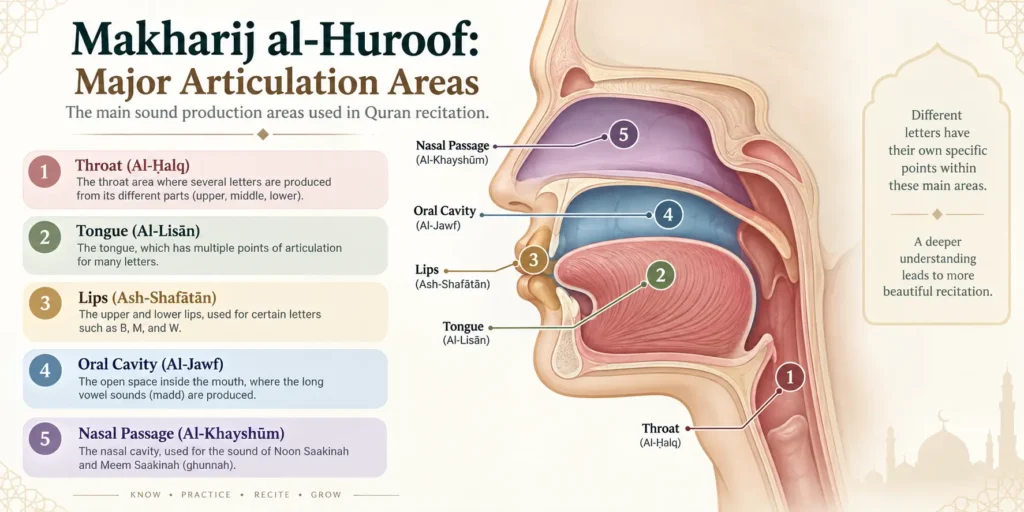
For English-speaking learners, this area is especially important because some Arabic sounds require different mouth positions.
Waqf and Ibtida (Pause and Start)
Waqf means stopping during Quran recitation, while Ibtida refers to starting.
Correct stopping and starting helps preserve the meaning of Quran verses.
A reader should learn where pauses are suitable instead of stopping randomly.
10 Common Tajweed Mistakes Beginners Make
Beginners commonly struggle with certain areas of Tajweed.
Common mistakes include:
- Confusing similar Arabic letters.
- Missing ghunnah where it is required.
- Adding extra vowel sounds to Qalqalah.
- Stretching Madd incorrectly.
- Pronouncing every Ra the same way.
- Not applying Idgham correctly.
- Confusing heavy and light letters.
- Stopping in places that affect meaning.
- Pronouncing Sun Letters incorrectly.
- Ignoring articulation points.
Recognizing these mistakes helps learners focus their practice.
How to Start Learning Tajweed (Practical Steps)
Reading Tajweed rules is useful, but recitation improves through listening and practice.
A practical learning path is:
- Learn Arabic letters and basic reading.
- Understand Noon Sakinah and Meem Sakinah rules.
- Learn the main Madd rules.
- Practice pronunciation with guidance.
- Listen to skilled Quran reciters.
- Compare your recitation with correct examples.
For beginners, using a Tajweed Mushaf can also help connect the rules they learn with the color indicators used during Quran reading.
Conclusion
Tajweed is not about memorizing complicated terms. It is about learning how each Quran letter should be pronounced and applying those rules during recitation.
For beginners, it is usually more practical to build a strong foundation before trying to master every Tajweed rule at once. Strong basics in pronunciation, Noon Sakinah, Meem Sakinah, Madd, and articulation make the rest of Tajweed much easier.
The best progress comes from combining knowledge with listening and practice. Tajweed becomes clearer when learners hear correct recitation and apply each rule carefully. Start with patience, learn step by step, and keep improving your connection with the Quran.
Frequently Asked Questions About Tajweed Rules
Is learning Tajweed necessary for Quran recitation?
Learning Tajweed helps readers pronounce Quranic words correctly and avoid common recitation mistakes. While scholars differ on whether every detailed Tajweed rule is obligatory, learning correct pronunciation and avoiding serious recitation errors are important.
How many Tajweed rules are there?
There is no single fixed number because Tajweed includes many connected categories and smaller rules.
Can beginners learn Tajweed?
Yes, beginners can learn Tajweed by starting with basic pronunciation rules and building knowledge step by step.
Can I learn Tajweed online?
Yes, online learning can provide structured lessons and guidance for people who want to improve their Quran recitation.
How long does it take to learn Tajweed?
The time varies depending on practice, starting level, and learning method. Applying Tajweed naturally requires regular practice.

tahamehmood895@gmail.com
tahamehmood895@gmail.com shares helpful Quran learning, Tajweed and Islamic education guidance for Quran Learning UK readers.
Related Quran Learning Guides