How to Read Arabic Words: A Beginner’s Step-by-Step Guide
Introduction You can recognize Arabic letters on their own, but the moment those letters join together into a real word, everything suddenly looks unfamiliar. A letter you knew a moment…
Introduction
You can recognize Arabic letters on their own, but the moment those letters join together into a real word, everything suddenly looks unfamiliar. A letter you knew a moment ago seems to change shape, and you start wondering why reading Arabic still feels so difficult.
The truth is that knowing the alphabet and reading Arabic words are two different skills. Reading a word means understanding how letters connect, recognizing vowel marks, and blending individual sounds together — and this becomes far clearer once you learn it in the right order.
This guide walks through that order: starting with letter recognition, moving into connected forms, then vowelled words, and finally full sentences. The aim isn’t to memorize a list of words — it’s to understand the system behind Arabic reading so any new word becomes readable.
Understanding the Foundation Before Reading Arabic Words
Arabic is written right to left, and unlike English, its letters connect to the ones around them — so the same letter can look different depending on where it sits in a word. This can feel disorienting at first, but the letter itself never actually changes. Only its shape does.
Take the letter ب as an example:
<table> <thead> <tr><th>Position</th><th>Form</th></tr> </thead> <tbody> <tr><td>Isolated</td><td>ب</td></tr> <tr><td>Beginning</td><td>بـ</td></tr> <tr><td>Middle</td><td>ـبـ</td></tr> <tr><td>End</td><td>ـب</td></tr> </tbody> </table>
Recognizing these shifting forms is the bridge between knowing Arabic letters and actually reading Arabic words.
Learn the Alphabet Before Combining Letters Into Words
How many letters are in the Arabic alphabet?
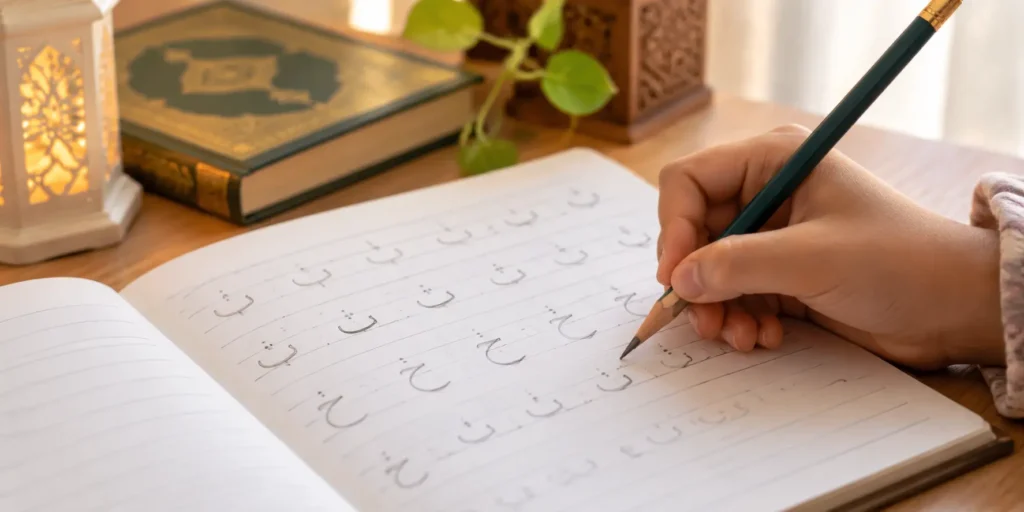
The Arabic alphabet is commonly taught as 28 letters, and these form the foundation for every word you’ll read. Some letters share the same basic shape and are distinguished only by dots — ب, ت, and ث are a good example, where the outline is nearly identical but the number and placement of dots changes both the letter and its sound.
This is why learning a letter’s shape alone isn’t enough — you need to pair it with its sound from the start, since the two are what actually let you read.
Learn the Sounds, Not Just the Names
Many beginners can name every letter of the alphabet but still get stuck the moment those letters appear inside a real word. Knowing a letter’s name doesn’t automatically mean you can read it in context — reading means turning written symbols into sound, in real time.
A useful sequence to build that skill:
- Recognize the letter
- Recall its sound
- Notice its position in the word
- Combine it with the letters around it
Some Arabic sounds don’t have a close match in English, so pronunciation is worth learning carefully from the start rather than approximating — approximated sounds are hard to correct later.
Why Arabic Letters Change Shape Inside Words
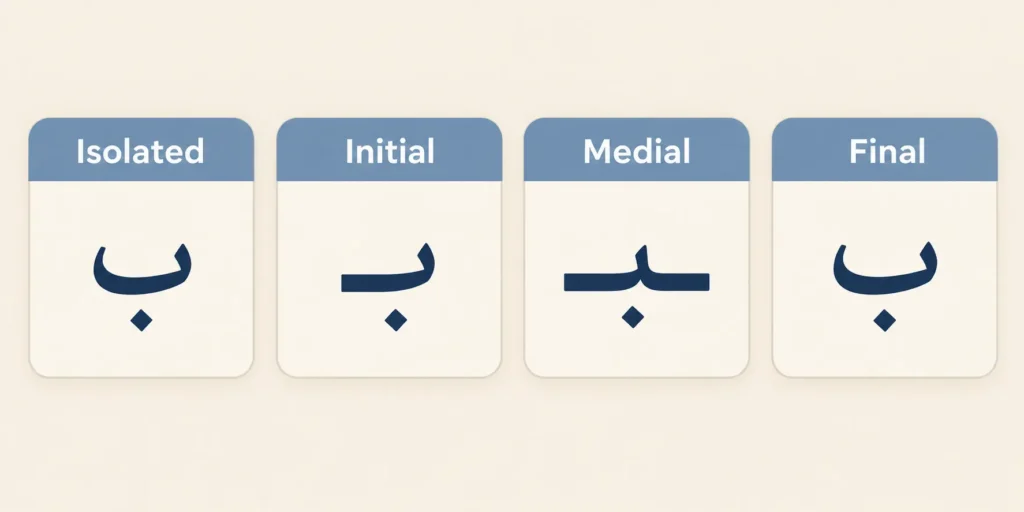
Arabic script works like connected handwriting, which is why most letters take a different form depending on where they fall in a word. There are four positions to know:
Isolated form — the standalone shape you first learn in the alphabet, used when a letter isn’t connected to anything.
Initial form — appears at the start of a word and connects forward to the letter after it.
Medial form — appears in the middle of a word and connects on both sides, where the letter allows it.
Final form — appears at the end of a word, connecting back to the previous letter but not forward.
The Role of Vowel Marks (Harakat)
Arabic words become much easier to read once vowel marks are present. These marks — called Harakat — sit above or below a letter and show its short vowel sound.
<table> <thead> <tr><th>Vowel Mark</th><th>Name</th><th>Sound</th></tr> </thead> <tbody> <tr><td>َ</td><td>Fathah</td><td>a sound</td></tr> <tr><td>ِ</td><td>Kasrah</td><td>i sound</td></tr> <tr><td>ُ</td><td>Dammah</td><td>u sound</td></tr> </tbody> </table>
The same letter can carry three completely different sounds depending on which mark sits on it — which is exactly why unmarked Arabic requires more vocabulary and context to read correctly.
Vowelled vs. Unvowelled Arabic
<table> <thead> <tr><th>Type</th><th>Description</th><th>Difficulty for Beginners</th></tr> </thead> <tbody> <tr><td>Vowelled Arabic</td><td>Includes Harakat showing pronunciation</td><td>Easier — every sound is marked</td></tr> <tr><td>Unvowelled Arabic</td><td>Short vowels aren’t written</td><td>More advanced — requires vocabulary knowledge</td></tr> </tbody> </table>
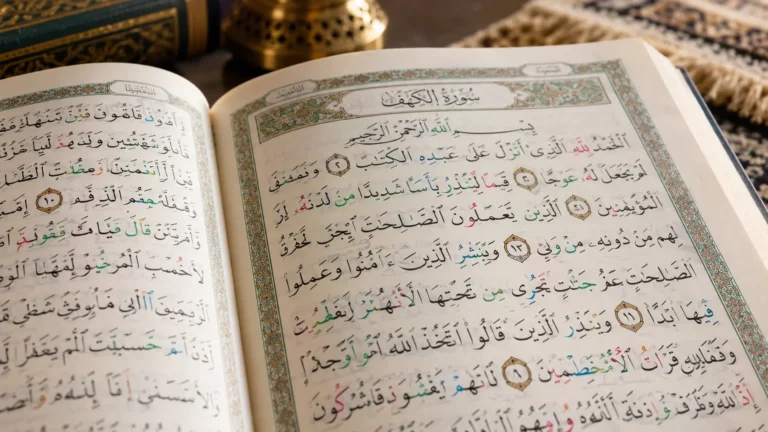
Most beginner learning materials — and the Quran itself — use vowelled text, which is exactly why they’re a good starting point: every sound is marked, so there’s nothing left to guess. Many learners specifically use a tajweed mushaf where these rules are marked directly in the text with color-coded symbols. Unvowelled Arabic comes later, once you have enough vocabulary to supply the missing vowels from context.
How to Read Arabic Words, Step by Step
Step 1: Start from the right. The first habit to build is reading right to left — it feels backwards at first if you’re used to English, but it becomes automatic with repetition.
Step 2: Identify each connected letter. Before attempting pronunciation, look at the word and mentally separate the letters. Ask yourself what letters you’re seeing, what shape each one is in, and whether it’s in its beginning, middle, or ending form.
Step 3: Add the vowel sounds. Once the letters are clear, check the Harakat — they tell you exactly how each letter should sound, and skipping this step is what causes the common mistake of reading the right letters with the wrong pronunciation.
Step 4: Blend the sounds together. With each letter and vowel identified, combine them into one flowing word. This will feel slow at first, and that’s expected — accuracy matters more than speed at this stage, and speed comes naturally once the letters stop requiring conscious effort.
Practicing After You Know the Basics
Knowing the rules is only half the process — the next step is applying them to real words. Many beginners feel comfortable with individual letters but freeze up the moment a complete word appears, simply because reading now requires recognizing connected shapes and blending sounds at the same time.
Start with simple, fully vowelled words and work through them in order: look at the first letter from the right, identify its connected form, read its vowel mark, then move to the next letter and join the sounds together. Repeating this sequence consistently is what turns Arabic reading from a confusing guessing game into a clear, repeatable process.
Reading Vowelled Words and Building Confidence
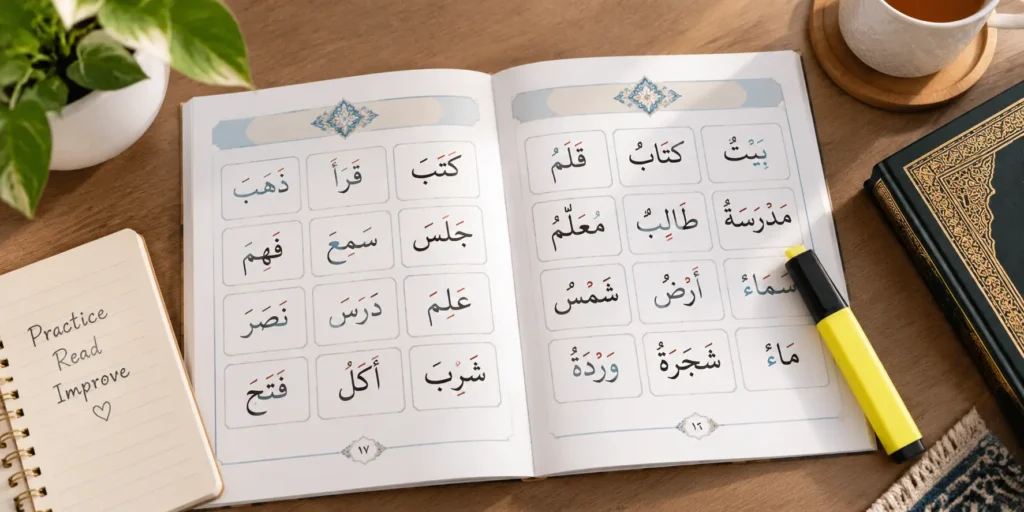
Decoding simply means turning written letters and vowel marks into sound — and at this stage, correctness matters far more than speed. It’s completely normal to pause between letters while your brain builds the connection between the written form and the spoken sound.
With repetition, the same words start to feel familiar. Instead of sounding out every letter separately, you begin recognizing whole word patterns at a glance — which is exactly the foundation you’ll need before moving on to longer text.
Moving From Words to Sentences
Once individual words feel manageable, the next stage is short sentences and passages. This shift feels different because reading stops being purely about pronunciation — you start connecting words together and following meaning across a line.
One effective way in is to read text you already know by sound. Learners working toward Quran reading, for instance, often start with short passages they already recognize from hearing them recited, which strengthens the link between seeing the text and reading it. The progression looks like this: recognizing letters, then reading words, then following connected text.
Building Faster Reading Through Recognition
Arabic reading can feel slow at first because every word needs careful, letter-by-letter decoding. But repeated exposure changes that — common words gradually become familiar as whole units rather than something you have to sound out each time.
This matters because fluent reading isn’t just about knowing letters; it’s about comfort with patterns you’ve seen before. A practical way to build that comfort: reread the same passage more than once, pay attention to words that keep recurring, and keep prioritizing correct pronunciation over speed until accuracy feels automatic.
Understanding Unvowelled Arabic
Most beginners start with vowelled text and move to unvowelled Arabic later. Unvowelled text is harder because short vowels aren’t written at all — the reader has to rely on vocabulary and context to supply the correct pronunciation.
If unvowelled Arabic still feels difficult after some practice, that’s not a sign you’re behind — it’s simply a more advanced skill that builds directly on a solid foundation in vowelled reading.
Reading the Quran as Practice
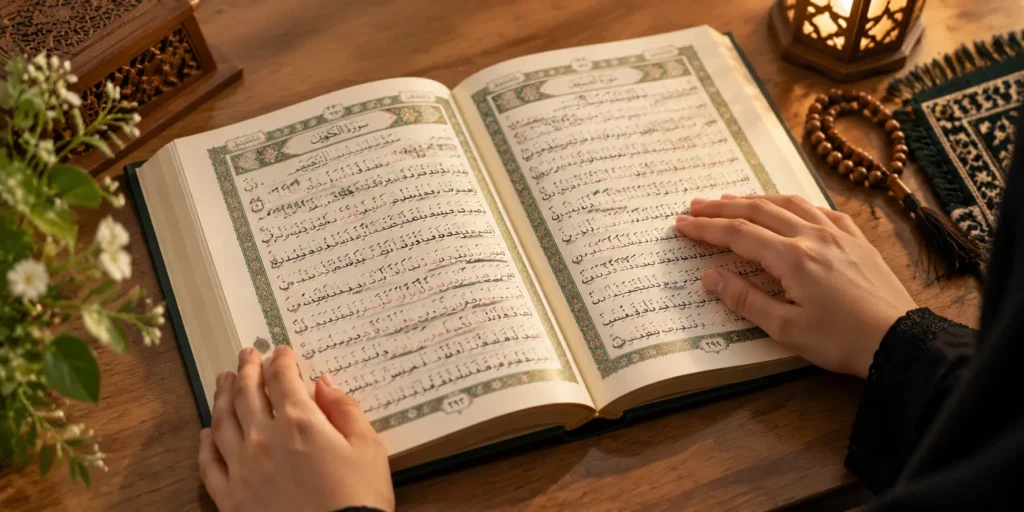
For many learners, reading the Quran is the actual reason they wanted to learn Arabic words in the first place — and it happens to be well suited for building that skill, since the text is fully marked with vowel signs that guide correct pronunciation as you go.
Working through familiar passages — ones you’ve already heard recited — ties together several things at once: the letters, the Harakat, correct pronunciation, and words you already recognize by ear. For many learners, this is also where reading practice starts to feel less like a technical exercise and more like building a direct connection with the text itself.
A Simple Daily Reading Routine
Consistency matters more than occasional long sessions. A short, repeatable routine works better than cramming:
<table> <thead> <tr><th>Time</th><th>Activity</th><th>Purpose</th></tr> </thead> <tbody> <tr><td>First part</td><td>Read a short vowelled passage aloud</td><td>Improve decoding accuracy</td></tr> <tr><td>Next part</td><td>Practice words you already recognize</td><td>Build recognition</td></tr> <tr><td>Next part</td><td>Reread the same passage</td><td>Improve smoothness</td></tr> <tr><td>Final part</td><td>Listen while following along in the text</td><td>Connect sound and writing</td></tr> </tbody> </table>

Fifteen minutes a day, done consistently, builds accuracy, recognition, and confidence together — far more effectively than an occasional long session. If you’d prefer structured feedback instead of practicing alone, joining online Quran classes with a tutor can help correct mistakes in real time.
Common Mistakes That Slow Down Progress
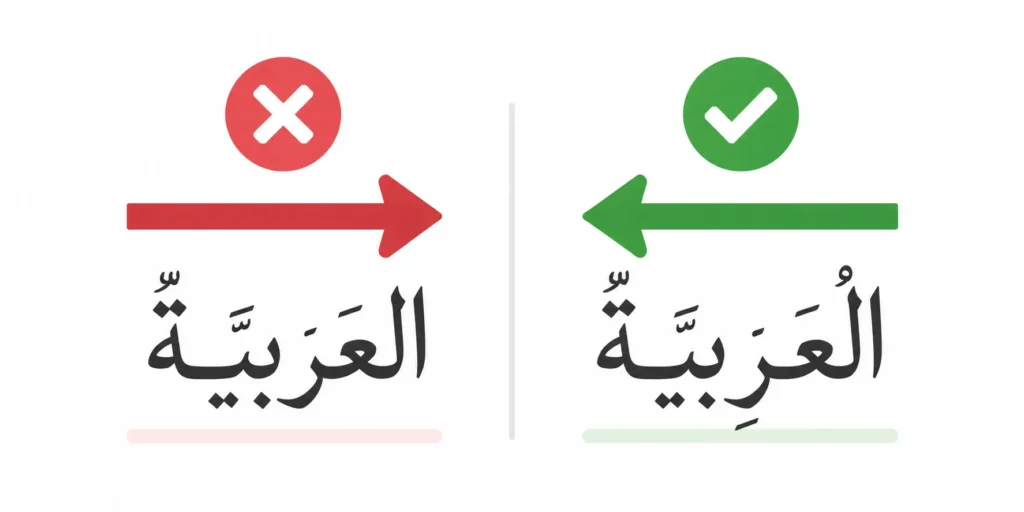
Reading left to right out of habit. This is usually the first instinct to unlearn, since it runs against everything else about how Arabic is structured.
Memorizing letters without ever reading full words. The alphabet is a starting point, not the destination — actual reading ability only develops once you start practicing connected letters in real words.
Skipping the Harakat. Vowel marks exist to guide pronunciation, and ignoring them is one of the fastest ways to create confusion as a beginner.
Trying to read too fast, too early. Speed is what comes after accuracy, not instead of it — reading slowly and correctly builds a stronger foundation than rushing through text and reinforcing mistakes.
Practical Ways to Improve
A few simple habits make a real difference over time: read aloud rather than silently, review familiar letters even while learning new ones, stay deliberate about pronunciation, and reread passages instead of constantly moving to new material. Choosing reading material that actually matches your current level also matters more than most beginners expect — a small amount of focused, well-matched practice tends to outperform reading large amounts of text you’re not ready for yet.
Conclusion
Reading Arabic words becomes far more manageable once you stop treating it as one single skill and start seeing it as a sequence: recognizing letters, understanding how they connect, reading the vowel marks, and blending sounds into complete words.
Beginners tend to do best when they resist the urge to jump into difficult texts too early. A solid foundation built on simple, vowelled words creates the confidence that makes everything after it easier — and Arabic script, unfamiliar as it looks at first, follows patterns that become second nature with consistent practice.
Frequently Asked Questions
How long does it take to learn how to read Arabic words?
It depends on your starting point and how consistently you practice. Learning happens in stages — letter recognition first, then vowelled words, then sentences, and eventually unvowelled text.
Do I need to learn Arabic grammar before reading words?
No. Beginners can start reading before studying grammar in depth — the first goal is simply recognizing letters, sounds, and vowel marks.
Why do Arabic letters change shape inside words?
Because Arabic letters connect to the ones around them, their shape shifts depending on position in the word. The letter itself never changes — only its form does.
Is reading Quranic Arabic the same as reading everyday Arabic?
Quranic text is fully marked with vowel signs, which helps beginners pronounce words accurately. Everyday written Arabic often leaves those marks out, which is part of why it’s considered a more advanced stage of reading.
What’s the best way to practice Arabic reading?
Consistent practice with material suited to your level. Start with vowelled text, prioritize accuracy over speed, and let recognition build gradually through repetition.

tahamehmood895@gmail.com
tahamehmood895@gmail.com shares helpful Quran learning, Tajweed and Islamic education guidance for Quran Learning UK readers.
Related Quran Learning Guides