Learning Tajweeed Through Poems: A Complete Guide to Tajweed Poetry
Learning Tajweeed though poems can feel confusing at first. Many learners want to understand the meaning of Tajweed and its role in correct Quran recitation, but they do not know…

Learning Tajweeed though poems can feel confusing at first. Many learners want to understand the meaning of Tajweed and its role in correct Quran recitation, but they do not know where to begin. There are many rules, terms, and learning resources, which can make the process feel overwhelming.
Tajweed poems offer a structured way to organize this knowledge. Instead of studying scattered rules, students can learn connected verses that explain important principles of Quran recitation. These poems have been used as learning texts because they help students remember and review complex concepts.
This approach is not about memorizing words without understanding. The strongest learning path combines memorization, explanation, and practical Quran recitation. Once students understand how these poems work, choosing the right starting point becomes much easier.
What Are Tajweed Poems and Why Are They Used?

Tajweed poems are classical learning texts written in a poetic form to present Quran recitation rules. Islamic scholars used this style to organize knowledge in a way that could be memorized and reviewed.
The poetic structure helps learners keep related concepts together. A student can study a section of verses, understand its meaning, and then connect those rules with Quran reading practice.
Tajweed poems usually focus on areas such as:
- Pronunciation of Quranic letters
- Characteristics of letters
- Rules of Noon Sakinah and Tanween
- Meem Sakinah rules
- Madd rules
- Stopping and starting rules
The purpose is not only memorization. The learner needs to understand what each verse teaches and how it applies during recitation.
Learning Tajweeed Though Poems: How This Method Works
Learning Tajweeed though poems works best when the student follows a clear process. A poem gives the learner a framework, but understanding remains essential.
A practical approach includes:
- Reading the poem with explanation.
- Understanding the Tajweed rule behind each line.
- Memorizing sections gradually.
- Reviewing the verses regularly.
- Applying the rules while reading Quran.
A common mistake is trying to memorize the poem without knowing its meaning. Memorization can preserve information, but understanding helps the learner use that information correctly.
The more practical option is to treat the poem as a learning map. Each section introduces a concept that should become part of Quran recitation.
What Is Matn Al-Jazariyyah?

Matn Al-Jazariyyah, also known as Al-Muqaddimah Al-Jazariyyah, is one of the well-known Tajweed poems used for studying Quran recitation rules.
The poem was composed by Imam Ibn al-Jazari, a scholar known for his work in Quran recitation. It presents important areas of Tajweed, including letter pronunciation, letter qualities, and recitation rules.
For many students, Al-Jazariyyah represents a deeper level of Tajweed study. It introduces detailed concepts that help learners understand the foundation behind correct recitation.
Before studying advanced sections, students benefit from understanding the basic ideas behind the verses. The poem becomes much easier when the learner knows what problem each rule solves.
Why Studying Al-Jazariyyah Helps Improve Tajweed
Al-Jazariyyah gives students an organized way to study Tajweed. Instead of learning individual rules without connection, learners can see how different areas of recitation fit together.
The poem covers important topics, including:
- Makharij al-Huruf, or articulation points of letters
- Sifaat al-Huruf, or characteristics of letters
- Tajweed principles
- Heavy and light pronunciation
- Rules related to specific letters
- Noon Sakinah and Tanween
- Madd and shortening
- Waqf and Ibtida, stopping and beginning
The value of the poem comes from its structure. It gathers important Tajweed knowledge into one study text.
The Main Sections Covered in Al-Jazariyyah
Introduction and Foundations
The opening sections introduce foundational concepts related to proper Quran recitation. They provide a basis for understanding the topics discussed throughout the poem.
Articulation Points of Letters
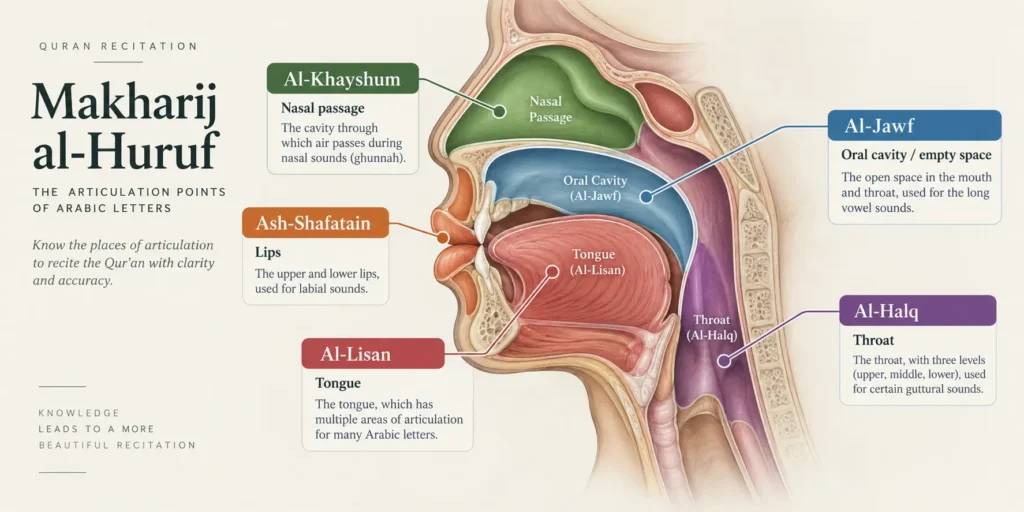
The section about Makharij al-Huruf explains where Arabic letters are produced. This helps learners understand why some letters require specific pronunciation.
Characteristics of Letters
The study of Sifaat al-Huruf focuses on the qualities that distinguish different letters. This area helps students improve accuracy.
Rules of Tajweed
The poem explains important rules of Tajweed for Quran recitation that students need for correct Quran reading.
Heavy and Light Pronunciation
Some Arabic letters have rules connected with heaviness and lightness. Understanding these principles improves pronunciation.
Rules of Ra and Lam
Certain letters have specific pronunciation guidelines. Studying these sections helps learners recognize special cases.
Noon Sakinah, Tanween, and Meem Sakinah
These are important Tajweed areas often studied by learners. The poem organizes these rules into a memorable format.
Madd Rules
Madd refers to lengthening in Quran recitation. The poem introduces principles related to proper timing and application.
Stopping and Starting Rules
Waqf and Ibtida help learners understand appropriate stopping and beginning points during recitation.
Tuhfat Al-Atfal and Al-Jazariyyah: Understanding the Difference
Two famous Tajweed poems are often discussed by students: Tuhfat al-Atfal and Al-Jazariyyah.
| Tajweed Poem | Learning Level | Main Focus |
| Tuhfat al-Atfal | Beginner-friendly | Basic Tajweed rules |
| Al-Jazariyyah | More advanced | Broader Tajweed principles |
Tuhfat al-Atfal is often associated with foundational Tajweed learning. It introduces essential rules in a simpler form.

Al-Jazariyyah covers a wider range of topics and provides a deeper study of Tajweed concepts.
The right choice depends on the learner’s current understanding. A beginner may benefit from a strong foundation before moving into more detailed material.
How to Memorize Tajweed Poems Effectively
Memorizing a Tajweed poem requires more than repeating verses. The learner needs a connection between the words, the explanation, and Quran practice.
Helpful study habits include:
- Understanding the explanation before memorization.
- Learning verses step by step.
- Reviewing previously learned sections.
- Connecting each rule with Quran recitation.
A qualified teacher can also help because Tajweed involves correct pronunciation. A learner may understand a rule but still need correction when applying it.
Understanding The Explanation Before Memorizing
The explanation of a Tajweed poem is called a Sharh. Understanding the Sharh helps students know what each verse means.
Without explanation, memorization can become a collection of words. With explanation, each line becomes connected to a real Tajweed concept.
This difference matters because the goal is not simply to complete the poem. The goal is to improve Quran recitation through correct understanding.
Who Can Benefit From Learning Tajweed Through Poems?
Tajweed poems can help different types of learners, including:
- Quran beginners who want a structured foundation.
- Students who know basic reading but need stronger Tajweed knowledge.
- Adults improving their Quran recitation.
- Learners who prefer organized memorization methods.
- Students studying classical Islamic learning texts.
The key is choosing a learning approach that matches the student’s level.
For learners who prefer guided lessons, a structured program such as the best online tajweed course can provide organized study support alongside poem-based learning.
Common Challenges When Learning Tajweed Poems
Learning through poems has many benefits, but it also requires patience.
Some challenges include:
- Classical Arabic wording may feel difficult.
- Some verses need explanation before they become clear.
- Memorization alone does not guarantee correct application.
The solution is balance. Students should combine the poem with understanding and Quran practice.
How to Begin Your Tajweed Poem Learning Journey
A good starting path is simple:
- Understand basic Tajweed concepts.
- Begin with a suitable poem.
- Study the explanation.
- Memorize sections carefully.
- Apply the rules during Quran reading.
The purpose of learning these poems is not only completing a text. It is building a stronger connection between Tajweed knowledge and actual recitation.
Conclusion
My view is that Tajweed poems are valuable because they give learners a clear structure instead of leaving them with disconnected rules. However, the poem itself is only a tool. Real improvement comes when memorization, explanation, and Quran practice work together.
For a learner feeling lost among many Tajweed resources, starting with the right poem and understanding its purpose can make the path much clearer. The goal is not simply to remember verses about Tajweed. The goal is to use that knowledge to recite the Quran with greater accuracy and confidence.
Frequently Asked Questions
What is the best Tajweed poem for beginners?
Tuhfat al-Atfal is commonly discussed as a beginner-level Tajweed poem because it focuses on foundational rules. Learners can later move toward deeper texts such as Al-Jazariyyah.
Can I learn Tajweed through poems without knowing Arabic?
Yes, learners can study Tajweed poems with translations and explanations. Understanding the meaning of the verses is important because memorization alone is not enough.
What is Al-Jazariyyah used for?
Al-Jazariyyah is used as a study text for deeper Tajweed learning. It covers areas such as letter articulation, characteristics, and important recitation rules.
Should I memorize a Tajweed poem first or understand it first?
Understanding the meaning can make memorization more useful. Learners can study the explanation alongside memorization so that they understand what they are learning.
Do Tajweed poems replace Quran practice?
No, Tajweed poems support Quran learning but do not replace practical recitation. Students need to apply the rules while reading Quran.

tahamehmood895@gmail.com
tahamehmood895@gmail.com shares helpful Quran learning, Tajweed and Islamic education guidance for Quran Learning UK readers.
Related Quran Learning Guides