
Hajj Dua: Essential Supplications for Every Pilgrim
Preparing for Hajj can feel overwhelming, especially when you’re trying to remember what to recite at each stage. A reliable hajj dua reference makes that preparation easier. From travelling and…
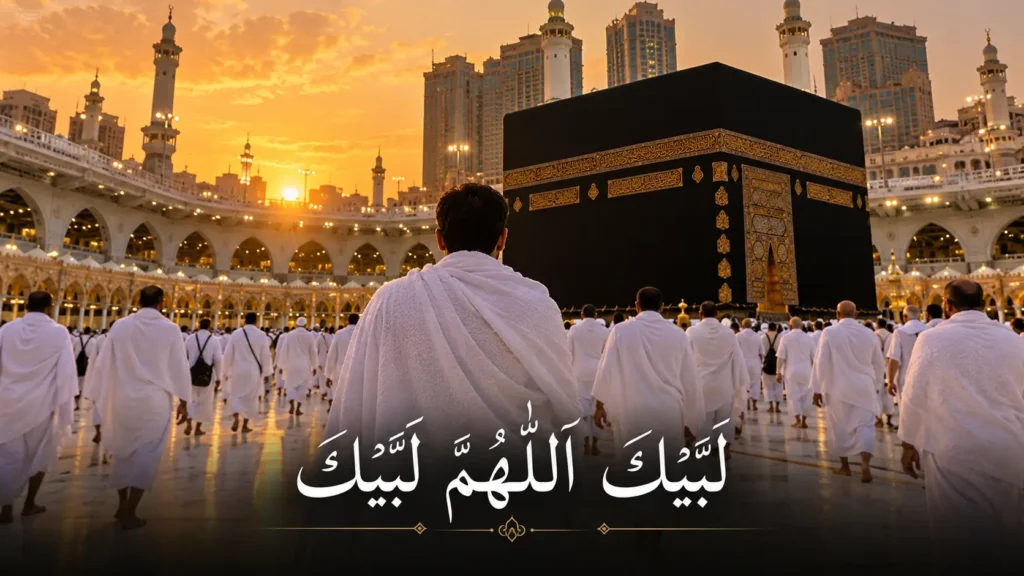
Preparing for Hajj can feel overwhelming, especially when you’re trying to remember what to recite at each stage. A reliable hajj dua reference makes that preparation easier. From travelling and entering Ihram to Tawaf, Safa and Marwah, Arafah, Muzdalifah, and the return home, knowing the words and their meanings helps you focus on worship rather than worry about what comes next.
You don’t need to treat Hajj as a long script that must be memorized perfectly. Some moments have established words of remembrance from the Sunnah, while at other times you’re free to make sincere personal dua and dhikr. What matters is knowing that difference and understanding what you’re saying.
Why Dua Matters During Hajj and Umrah
Dua is part of the spiritual heart of pilgrimage. Hajj and Umrah are acts of worship, repentance, remembrance, and turning toward Allah. During these rites, a pilgrim can ask for forgiveness, guidance, protection, and goodness in this life and the Hereafter.
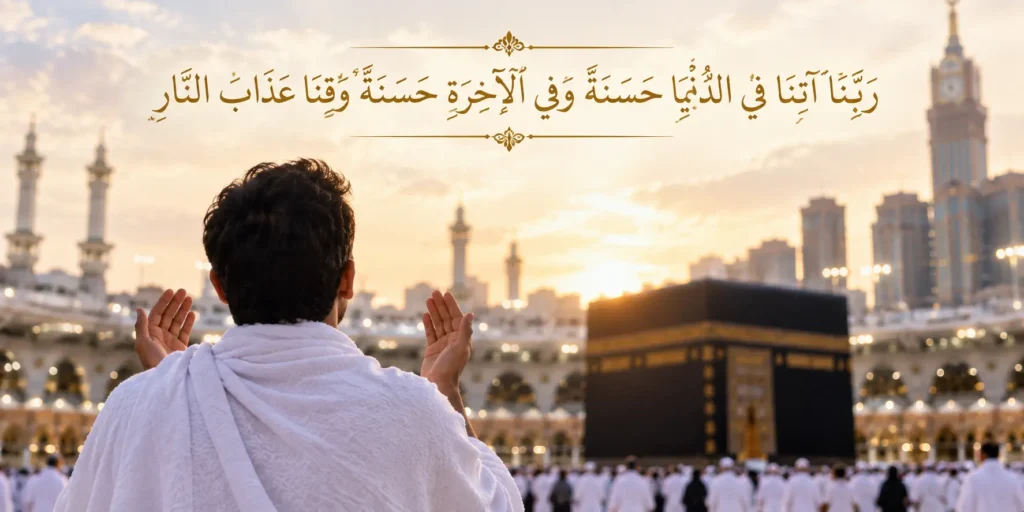
Dua also keeps intention at the center of the journey. Tawaf and Sa’i aren’t simply movements to complete — they’re moments of worship. Likewise, standing at Arafah offers one of the most important opportunities in Hajj for supplication, remembrance, and seeking forgiveness.
Personal dua can extend beyond your own needs. You may pray for your parents, family, the Muslim community, and others who have asked you to remember them. During tiring travel and crowded conditions, remembrance of Allah can also help keep your attention connected to the purpose of Hajj.
The practical point is simple: don’t approach every dua as another line you must memorize. Learn the important established words, understand their meanings, and know where sincere personal supplication fits.
Hajj Dua for Travel
Spiritual preparation for Hajj begins before you even reach Makkah. When travelling, it’s Sunnah to say:
اَللّٰهُ أَكْبَرُ
Transliteration: Allahu Akbar
Meaning: Allah is the Most Great.
Then:
سُبْحَانَ الَّذِيْ سَخَّرَ لَنَا هٰذَا وَمَا كُنَّا لَهُ مُقْرِنِيْنَ، وَإِنَّا إِلَى رَبِّنَا لَمُنْقَلِبُوْنَ
Transliteration: Subhana alladhi sakhkhara lana hadha wa ma kunna lahu muqrinin, wa inna ila rabbina lamunqalibun.
Meaning: Glory is to Him Who has provided this for us, though we could never have had it by our efforts. Surely, unto our Lord we are returning.
This is a useful point to shift your attention from travel logistics toward worship. Leaving home, boarding transport, and arriving are not merely steps toward a destination — they mark the beginning of the pilgrimage experience itself.
Hajj Dua at the Miqat and Entering Ihram
Miqat can feel like a major turning point, especially for a first-time pilgrim. Instead of making the moment complicated, focus on the purpose of entering Ihram and the remembrance connected with it.
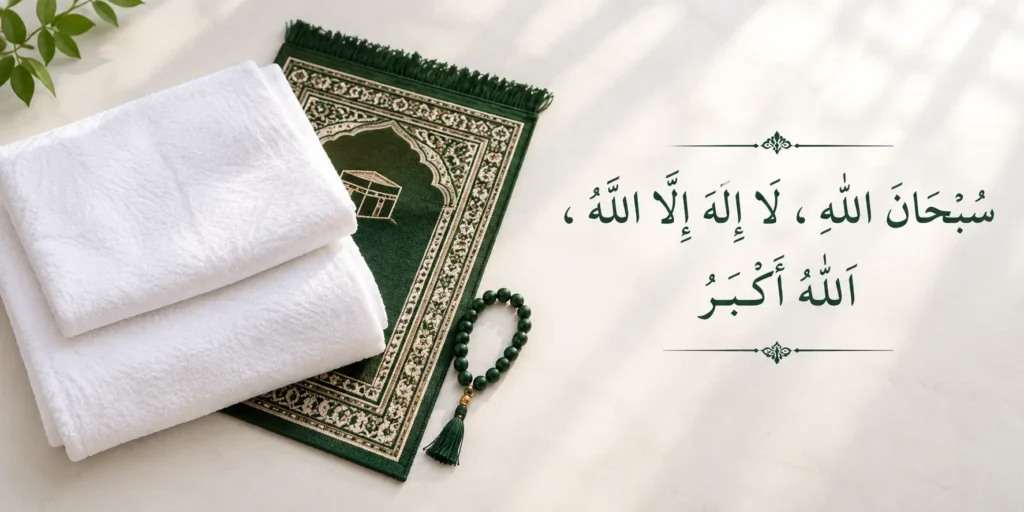
Before entering Ihram, it’s recommended to recite Tasbih, Tahlil, and Takbeer:
سُبْحَانَ اللّٰهِ ، لَا إِلٰهَ إِلَّا اللّٰهُ ، اَللّٰهُ أَكْبَرُ
Transliteration: Subhanallahi, la ilaha illallahu, Allahu Akbar.
Meaning: Glory be to Allah, there is no god but Allah, Allah is Most Great.
Some guides include additional, more detailed supplications connected with Ghusl, wearing the garments of Ihram, and preparation before making the intention. These details vary between scholarly traditions and sources, so they shouldn’t be treated as a single fixed formula every pilgrim must recite word for word.
Intention and Ihram
One point deserves special attention: intention is primarily in the heart. You don’t need to invent a compulsory sentence and become anxious about pronouncing it perfectly.
Know what you intend to perform for Allah, then give your attention to the Talbiyah — the recitation that is clearly established in the Sunnah for this stage.
Talbiyah for Hajj and Umrah
Talbiyah is one of the central recitations a pilgrim should recognize and understand.
لَبَّيْكَ اَللّٰهُمَّ لَبَّيْكَ، لَبَّيْكَ لَا شَرِيْكَ لَكَ لَبَّيْكَ، إِنَّ الْحَمْدَ، وَالنِّعْمَةَ، لَكَ وَالْمُلْكُ، لَا شَرِيْكَ لَكَ
Transliteration: Labbayk Allahumma labbayk. Labbayka la sharika laka labbayk. Innal-hamda wan-ni’mata laka wal-mulk. La sharika lak.
Meaning: At Your service, Allah, at Your service. At Your service, You have no partner, at Your service. Truly, all praise, favour, and sovereignty are Yours. You have no partner.
Don’t let the transliteration become a string of unfamiliar sounds. Its meaning is what gives the Talbiyah its force — the pilgrim is answering Allah’s call with worship and declaring that praise and sovereignty belong to Him alone.
Entering the Haram and Approaching the Kaaba
Reaching the sacred precinct can be one of the most emotional parts of the pilgrimage. There are established supplications connected with entering the Haram, entering Masjid al-Haram, seeing the Kaaba, and approaching Hajar al-Aswad (the Black Stone).
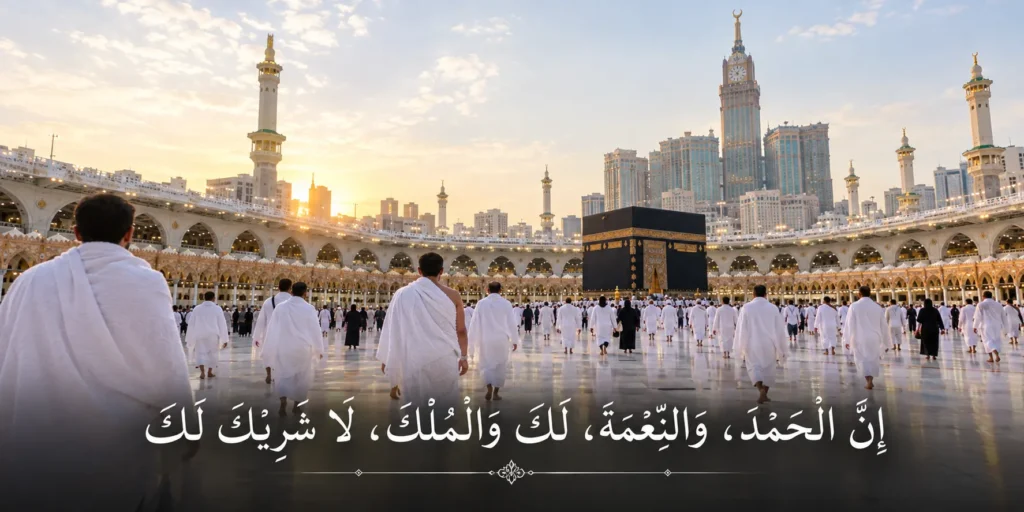
This is also where careful organization matters. Entering the Haram and entering Masjid al-Haram are not the same stage — keeping those moments separate helps a first-time pilgrim understand where each supplication belongs.
Rather than rushing through a long list, stay focused on worship and the meaning of the moment. Where a specific supplication is established, learn it with its context. Where no fixed wording exists, there’s no need to turn personal prayer into an invented requirement.
What to Say at the Black Stone
During Tawaf, it’s authentically reported that the Prophet ﷺ said Takbir when reaching the Black Stone.
Say:
اَللّٰهُ أَكْبَرُ
Transliteration: Allahu Akbar
Meaning: Allah is the Most Great.
This is one of those moments where simplicity helps. You don’t need to bury a short remembrance beneath pages of explanation. Know what is said, recognize the point during Tawaf, and understand its meaning.
Dua Between the Yemeni Corner and Black Stone
Between the Yemeni Corner and the Black Stone, it’s established Sunnah to recite:
رَبَّـنَا آتِنَا فِي الدُّنْيَا حَسَنَةً وَفِي الآخِرَةِ حَسَنَةً وَقِنَا عَذَابَ النَّارِ
Transliteration: Rabbana atina fid-dunya hasanatan wa fil-akhirati hasanatan wa qina ‘adhaban-nar.
Meaning: Our Lord, grant us the good of this world and the Hereafter, and protect us from the torment of the Fire.
This dua, from the Quran, is brief, yet its meaning reaches across worldly life and the Hereafter. Taking time to reflect on the words of this dua helps you understand what you’re actually asking Allah for.
Do You Need a Different Dua for Every Tawaf Circuit?
No, and this point can remove a lot of unnecessary pressure. There’s no authentic report from the Prophet ﷺ specifying particular duas or adhkar for each individual circuit of Tawaf. You’re free to make sincere dua or recite dhikr while performing it.
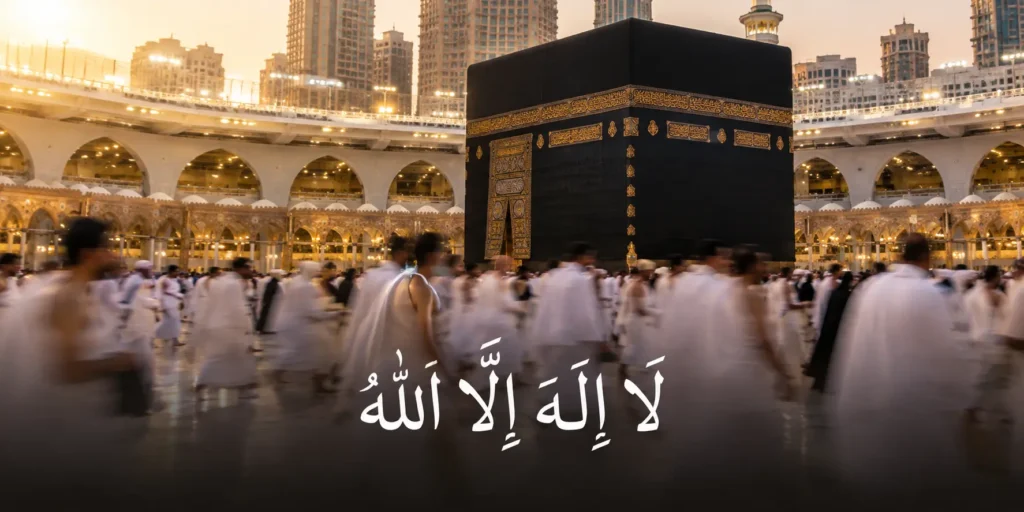
That distinction matters. A printed booklet or guide can be useful for preparation, but it shouldn’t make you believe that every circuit requires its own compulsory script.
This is one of the most reassuring things for a first-time pilgrim to understand. Learn the established remembrance where it exists, and for the remaining time, turn to Allah sincerely instead of worrying that you’ve missed a numbered prayer.
Dua at Safa and Marwah
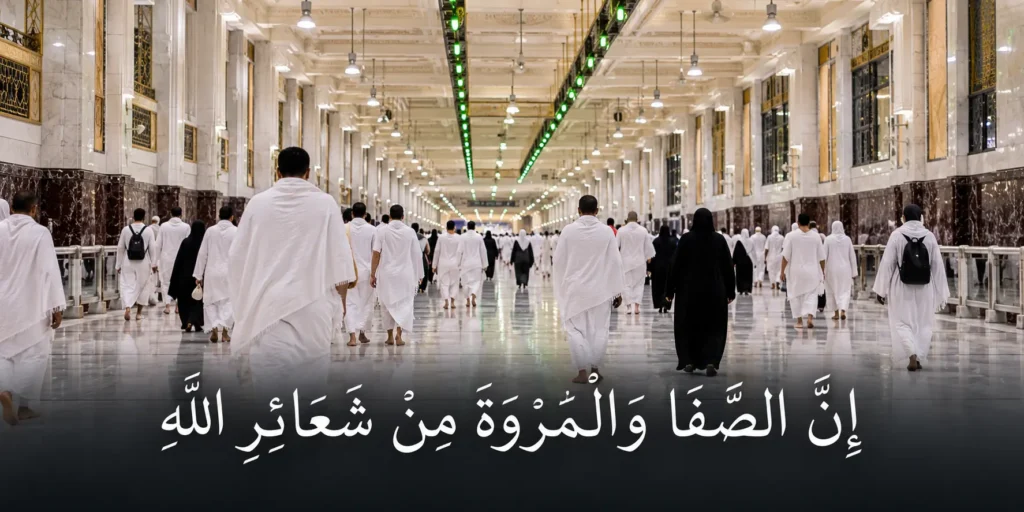
There’s a clear, established sequence for Safa and Marwah. When approaching Safa, recite:
إِنَّ الصَّفَا وَالْمَرْوَةَ مِنْ شَعَائِرِ اللَّهِ
Transliteration: Inna as-safaa wal-marwata min sha’aa’iri Allahi.
Meaning: Indeed, as-Safa and al-Marwah are among the symbols of Allah.
Then say:
أَبْدَأُ بِمَا بَدَأَ اللَّهُ بِهِ
Transliteration: Abda’u bima bada’ Allahu bihi.
Meaning: I begin by that which Allah began.
At Safa, while facing the Kaaba, recite:
لَا إِلٰهَ إِلَّا اللَّهُ وَحْدَهُ لَا شَرِيكَ لَهُ، لَهُ الْمُلْكُ وَلَهُ الْحَمْدُ وَهُوَ عَلَىٰ كُلِّ شَيْءٍ قَدِيرٌ، لَا إِلٰهَ إِلَّا اللَّهُ وَحْدَهُ، أَنْجَزَ وَعْدَهُ، وَنَصَرَ عَبْدَهُ، وَهَزَمَ الْأَحْزَابَ وَحْدَهُ
Transliteration: La ilaha illallahu wahdahu la sharika lahu, lahul-mulku wa lahul-hamdu wa huwa ‘ala kulli shay’in qadir. La ilaha illallahu wahdahu, anjaza wa’dahu, wa nasara abdahu, wa hazamal-ahzaaba wahdahu.
Meaning: None has the right to be worshipped but Allah alone, with no partner. His is the dominion and praise, and He is able to do all things. Allah alone fulfilled His promise, aided His servant, and defeated the Confederates.
After this, there’s space to ask Allah for what you wish, and the same sequence of remembrance observed at Safa is repeated at Marwah. This combination of established remembrance and personal supplication is worth keeping clear in your mind.
Dua When Drinking Zamzam Water
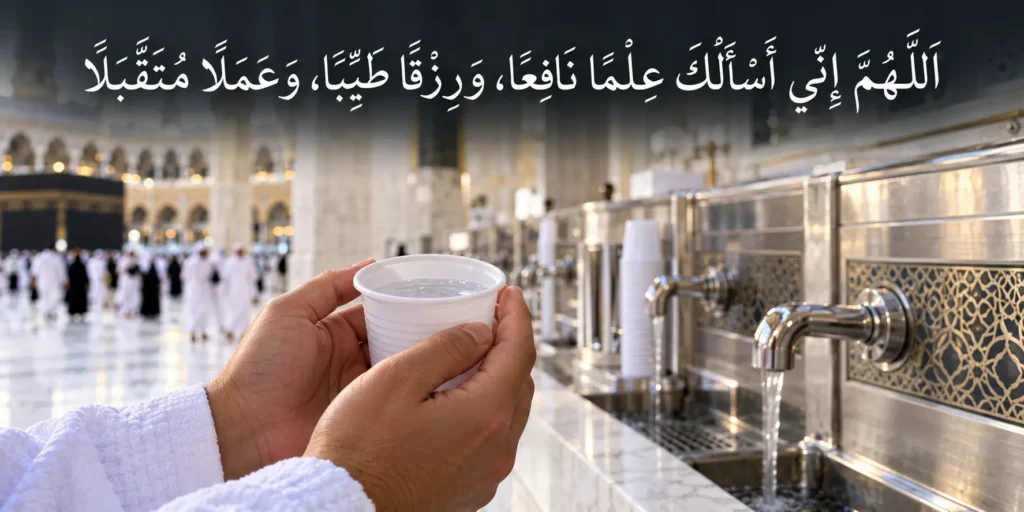
This dua is recited in connection with drinking Zamzam:
اللَّهُمَّ إِنِّي أَسْأَلُكَ عِلْمًا نَافِعًا، وَرِزْقًا طَيِّبًا، وَعَمَلًا مُتَقَّبَلًا
Transliteration: Allahumma inni as’aluka ‘ilman nafi’an, wa rizqan tayyiban, wa ‘amalan mutaqabbalan.
Meaning: O Allah, I ask You for beneficial knowledge, pure sustenance, and accepted actions.
This is another moment where understanding the words changes the experience. The requests concern beneficial knowledge, good provision, and accepted deeds — so rather than reading mechanically, know what you’re asking Allah to grant.
Dua and Remembrance at Arafah
Arafah deserves more attention than an ordinary entry on a checklist. The Day of Arafah is an especially significant time for supplication, forgiveness, and remembrance.
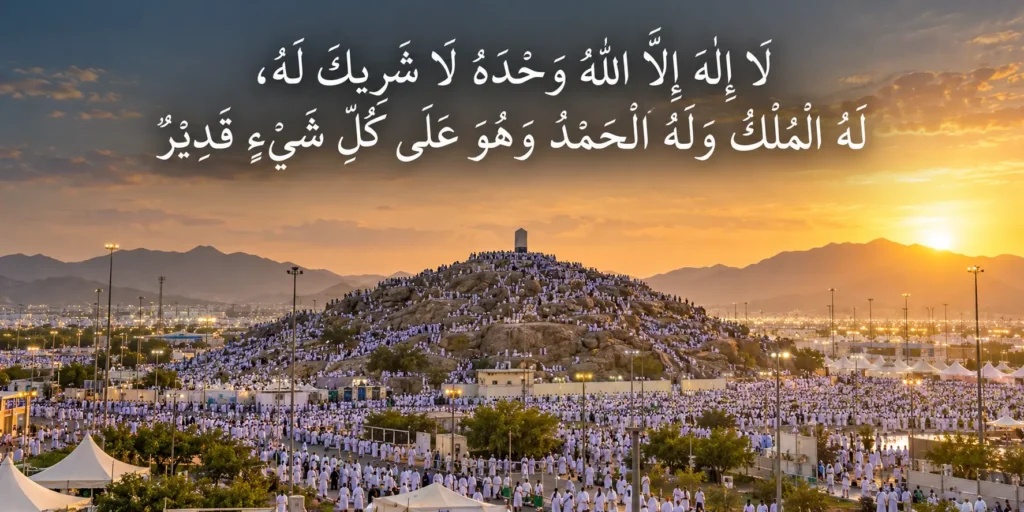
The best remembrance reported for this day is:
لَا إِلٰهَ إِلَّا اللّٰهُ وَحْدَهُ لَا شَرِيْكَ لَهُ، لَهُ الْمُلْكُ وَلَهُ الْحَمْدُ وَهُوَ عَلَی كُلِّ شَيْءٍ قَدِيْرٌ
Transliteration: La ilaha illallahu wahdahu la sharika lah, lahul-mulku wa lahul-hamdu wa huwa ‘ala kulli shay’in qadir.
Meaning: None has the right to be worshipped but Allah alone, Who has no partner. His is the dominion and praise, and He is able to do all things.
Don’t let concern about remembering a huge collection of words distract you from the purpose of Arafah. Supplication and remembrance are at the very center of this day.
This is also a natural place for personal dua. Ask Allah for forgiveness, guidance, acceptance, your family, and goodness in this life and the Hereafter. The important point isn’t producing an impressive script — it’s turning sincerely to Allah during this pivotal part of Hajj.
Dua and Worship at Muzdalifah and Mina
By the time a pilgrim reaches Muzdalifah, physical tiredness can make complicated instructions harder to follow. This stage of the journey calls for remembrance, supplication, prayer, and seeking forgiveness while moving from Arafah toward Muzdalifah.
At Mash’ar al-Haram, remembrance of Allah and His oneness is the focus — this part of the pilgrimage shouldn’t become another memorization task.
Mina, too, is a place for continued supplication and remembrance. Keep the sequence of Hajj clear in your mind. The practical aim is to know where you are in the rites and maintain remembrance, rather than feel overwhelmed by a growing list of texts to recall.
What to Say When Throwing Pebbles at the Jamarat
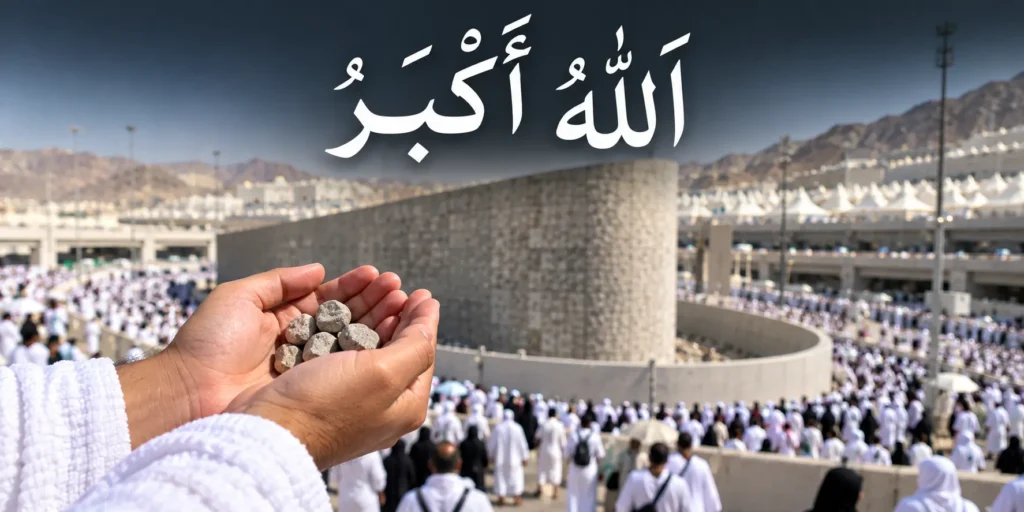
When throwing each pebble, say:
اَللّٰهُ أَكْبَرُ
Transliteration: Allahu Akbar
Meaning: Allah is the Most Great.
This is a good example of why a Hajj dua reference should stay practical. When the established wording is short, there is no benefit in making the instruction look complicated.
Saying Labbaik at Dhul Hulaifah
It’s narrated that the Prophet ﷺ began saying “Labbaik” at Dhul Hulaifah, the moment his mount stood upright to begin the journey.
For a first-time pilgrim, the key here is context, not memorization. “Dhul Hulaifah” isn’t another phrase you need to learn by heart — it’s simply the place connected with the start of saying the Talbiyah, which remains the important recitation to focus on.
Takbeer-e-Tashreeq During Hajj
Takbeer-e-Tashreeq is recited from Fajr on the 9th of Dhul Hijjah through Asr on the 13th of Dhul Hijjah, after each obligatory prayer:
اللَّهُ أَكْبَرُ اللَّهُ أَكْبَرُ لَا إلَهَ إلَّا اللَّهُ وَاَللَّهُ أَكْبَرُ اللَّهُ أَكْبَرُ وَلِلَّهِ الْحَمْد
Transliteration: Allahu akbar, Allahu akbar, la ilaha illallahu, wallahu akbar. Allahu akbar, wa lillahil-hamd.
Meaning: Allah is the greatest, Allah is the greatest. There is no deity besides Allah, and Allah is the greatest. Allah is the greatest, and all praise belongs to Allah.
Men pronounce this Takbeer loudly and women softly, after the obligatory prayers during the stated period.
Dua When Slaughtering the Animal
For the sacrifice connected with Hajj:
بِسْمِ اللّٰهِ وَاللّٰهُ أَكْبَرُ اَللّٰهُمَّ مِنْكَ وَلَكَ اَللّٰهُمَّ تَقَبَّلْ مِنِّيْ
Transliteration: Bismillahi wallahu akbar. Allahumma minka wa laka. Allahumma taqabbal minni.
Meaning: With the Name of Allah, Allah is the Most Great. O Allah, from You and to You. O Allah, accept it from me.
The final request for acceptance fits the wider spiritual focus of Hajj. The pilgrim isn’t merely completing outward actions — acceptance and sincere worship remain the central concern throughout.
Dua for Returning From Hajj or Umrah
Returning home doesn’t need to feel like an abrupt end to the spiritual experience. This remembrance is reported for returning from Hajj and other journeys:
آيِبُونَ تَائِبُونَ عَابِدُونَ لِرَبِّنَا حَامِدُونَ
Transliteration: Ayibuna ta’ibuna ‘abiduna lirabbina hamidun.
Meaning: We return, repentant, worshipping and praising our Lord.
Those words give the return journey an appropriate focus. You are going home, but repentance, worship, and gratitude don’t stay behind in Makkah.
Quick Hajj Dua Reference
- Travel — Travel remembrance and Takbir
- Miqat — Tasbih, Tahlil, Takbeer, and preparation for Ihram
- Ihram — Clear intention and Talbiyah
- Talbiyah — “Labbayk Allahumma labbayk…”
- Black Stone — “Allahu Akbar”
- Yemeni Corner to Black Stone — “Rabbana atina fid-dunya hasanatan…”
- Tawaf — Established remembrance where applicable; sincere dua and dhikr otherwise
- Safa and Marwah — Established remembrance followed by personal supplication
- Zamzam — Dua for beneficial knowledge, good provision, and accepted actions
- Arafah — Tawheed, remembrance, forgiveness, and sincere personal dua
- Muzdalifah and Mina — Remembrance, prayer, and supplication
- Jamarat — “Allahu Akbar”
- Sacrifice — “Bismillahi wallahu akbar…” and asking Allah for acceptance
- Return — “Ayibuna ta’ibuna ‘abiduna lirabbina hamidun”
This list is best used as a memory aid, not as proof that every moment of Hajj requires a different fixed prayer — that distinction matters most during Tawaf.
Conclusion
A good Hajj dua preparation shouldn’t leave you carrying the fear that one forgotten line will ruin an important moment. Talbiyah, the remembrance at Safa and Marwah, the dua between the Yemeni Corner and Black Stone, Arafah remembrance, and the other established words in this guide deserve careful preparation — but Hajj isn’t meant to become a race through memorized pages.
Go prepared, but leave room for sincerity. When you understand what you’re saying and why you’re saying it, the words can support the purpose of worship instead of becoming another source of worry.
FAQs
Do I need a different dua for every round of Tawaf?
No. There’s no authentic report specifying a different dua or dhikr for every part of Tawaf. You may make sincere dua and remember Allah while performing it.
What is the main Talbiyah for Hajj?
It begins, “Labbayk Allahumma labbayk, labbayka la sharika laka labbayk.” Its meaning centers on answering Allah’s call and affirming that praise, favour, and sovereignty belong to Him.
What is the best dua at Arafah?
“La ilaha illallahu wahdahu la sharika lah…” is the remembrance reported as the best for this day. Arafah is also a significant time for sincere supplication and seeking forgiveness.
Is there a specific dua that guarantees Hajj acceptance?
No specific dua guarantees acceptance. You can sincerely ask Allah to accept your worship, including with “Allahumma taqabbal minni,” meaning “O Allah, accept from me.”
Do I need to say a fixed sentence for Hajj or Umrah intention?
No. Intention is primarily in the heart, with no compulsory fixed sentence required. The Talbiyah is the established recitation connected with entering the pilgrimage rites.

tahamehmood895@gmail.com
tahamehmood895@gmail.com shares helpful Quran learning, Tajweed and Islamic education guidance for Quran Learning UK readers.