How Many Ayah in Quran? The Complete Explanation of Quran Verse Count
Introduction A simple question about the Quran’s structure can sometimes lead to confusion: how many ayah in Quran? Readers often find different numbers when searching for the answer — some…
Introduction
A simple question about the Quran’s structure can sometimes lead to confusion: how many ayah in Quran? Readers often find different numbers when searching for the answer — some sources mention 6,236 verses, while others repeat the commonly known figure of 6,666.
The answer becomes clearer once you look at how scholars have counted Quranic verses throughout history. The commonly used counting system gives a total of 6,236 Ayahs. Different traditional counting methods explain why some sources mention slightly different totals — and as this guide will show, those differences come down to how verses were numbered, not any change in the Quranic text itself.
The Standard Ayah Count
The Quran contains 6,236 Ayahs according to the widely used Kufic counting tradition associated with the Hafs narration — the number found in most modern Quran copies and digital Quran resources used around the world.
An Ayah is a verse or sign from the Quran. Each Ayah forms part of a Surah, and together all Ayahs make up the complete Quran. Understanding this structure helps readers see how the Quran is organized and why verse numbering matters for study, memorization, and reference.
The Quran is divided into 114 Surahs (chapters), and each Surah contains a different number of Ayahs — some Surahs run long, others are just a few verses. For a complete breakdown of each chapter, our 114 Surah names list covers every Surah along with its meaning.
Why Do Different Ayah Counts Exist?
Different Ayah counts exist because early Quran scholars used different methods for identifying where one verse ends and the next begins. These counting traditions developed among scholars in different regions — Madinah, Makkah, Kufa, Basra, and Damascus.
Seeing a slightly different number in another source doesn’t mean there’s disagreement about the Quran itself — the wording stays identical across all traditions. It simply reflects how verse divisions were historically marked and documented.
Traditional Quran Verse Numbering Methods
Several traditional systems were developed by scholars who studied Quran recitation and transmission to count Quranic verses. The main counting traditions include:
- Kufic count — associated with Kufa scholars
- Madinan count — associated with Madinah scholars
- Meccan count — associated with Makkah scholars
- Basran count — associated with Basra scholars
- Damascene count — associated with Damascus scholars
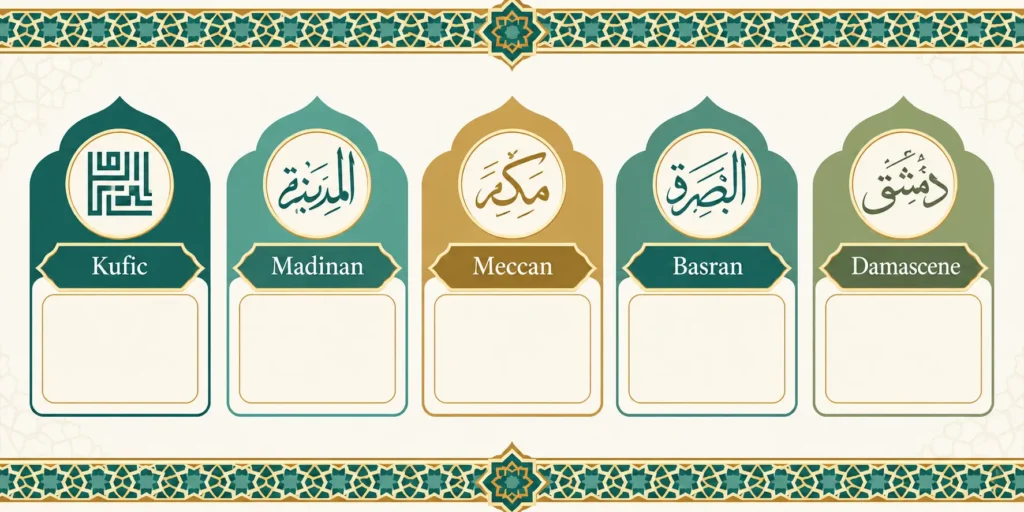
Of these, the Kufic count became the most widely used in printed Quran editions, particularly those following the Hafs narration. The existence of multiple traditions reflects how carefully scholars treated verse numbering as a serious area of Quranic study, not an afterthought. One of the most important classical works on this subject is Al-Bayan fi ‘Add Ay al-Qur’an (“The Clarification in Counting the Verses of the Quran”) by the 11th-century scholar Imam Abu ‘Amr Ad-Dani, whose writing remains a key reference for how these counting traditions were originally documented.
Does the Basmalah Count as an Ayah?
The Basmalah refers to the phrase “Bismillah ir-Rahman ir-Rahim,” which opens most Surahs. Whether it counts as a separate Ayah has long been discussed among scholars, and different counting traditions handle it differently — some count it as a verse in specific places, others don’t.
This is actually one of the main sources of the varying Ayah totals readers come across, and it’s a good example of how these differences trace back to scholarly counting conventions rather than any inconsistency in the Quran’s actual content.
The Truth Behind the 6,666 Ayah Figure
The number 6,666 comes up often in popular discussion of the Quran’s verse count, but it doesn’t match any of the standard scholarly counting systems — the commonly used count in Quran editions is 6,236.
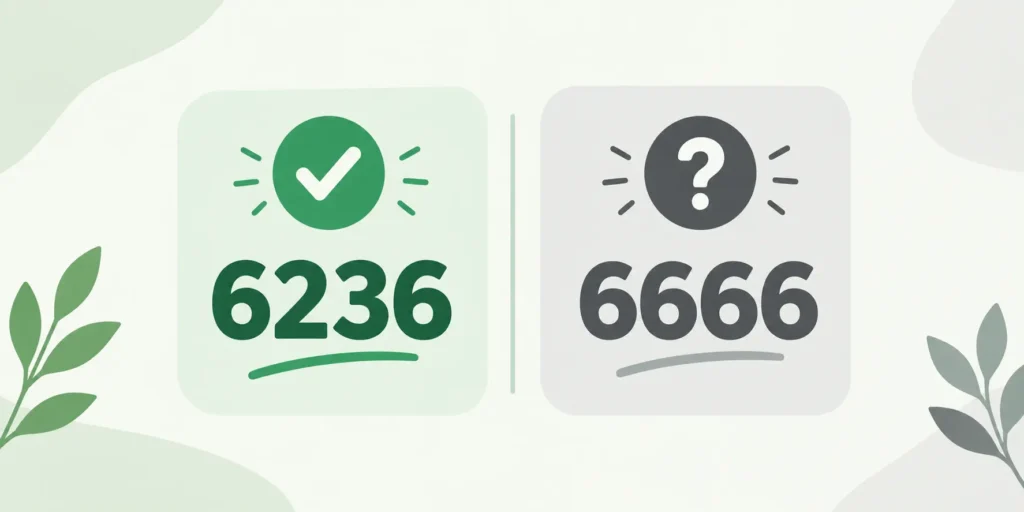
Recognizing the gap between this popular figure and the established counting methods helps clear up a common point of confusion. Whichever number a source cites, what stays constant is the Quran’s preserved text — only the verse-numbering convention changes.
Number of Surahs and Key Quran Structure Facts
The Quran’s 114 Surahs each have their own structure and length. A few key figures worth knowing:
- Total Surahs: 114
- Common Ayah count: 6,236
- Longest Surah: Al-Baqarah (286 Ayahs)
- Shortest Surah: Al-Kawthar (3 Ayahs)
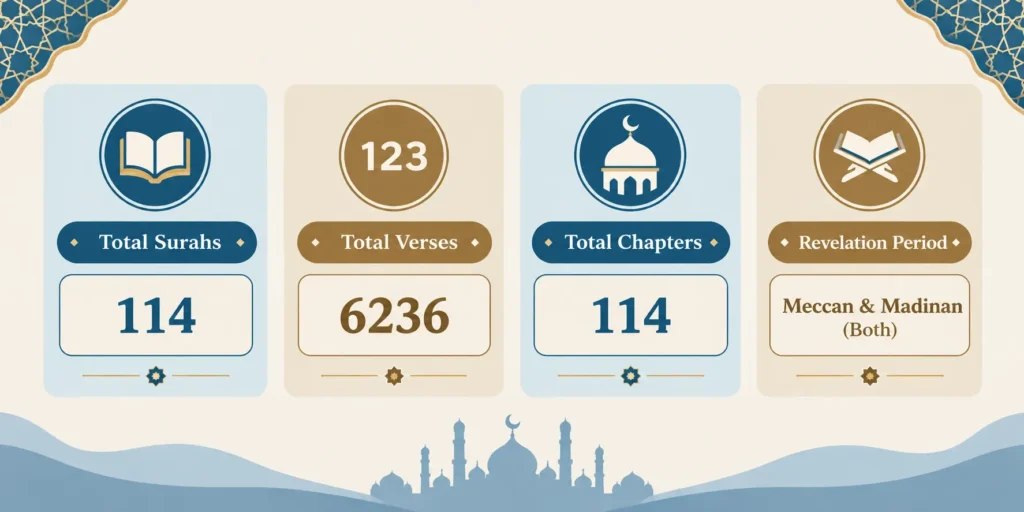
This range shows just how varied the Quran’s chapters are in length and structure.
Ayahs Across the 30 Juz
Beyond Surahs, the Quran is also divided into 30 Juz to help Muslims organize their reading and memorization. Each Juz contains portions of different Surahs — the division is a practical reading tool and doesn’t change the total Ayah count in any way.
Many readers rely on the Juz system during regular recitation, especially when working through the entire Quran over a set period, such as during Ramadan.
How the Quran’s Structure Has Been Preserved
The Quran’s structure has been preserved across generations through both memorization and written transmission, with scholars carefully documenting details like Surah arrangement and Ayah-numbering conventions.
This attention to detail is part of why verse divisions became such a well-studied area of Islamic scholarship in the first place. Understanding Ayah counts, Surah structure, and Juz divisions together gives readers a much clearer picture of how the Quran has been studied and organized throughout history.
Conclusion
The question of how many ayah in Quran has a straightforward headline answer — 6,236, based on the widely used Kufic count — but the fuller picture comes from understanding why that number sometimes varies across sources.
Knowing how scholars historically approached verse counting helps readers engage with this kind of information accurately rather than getting stuck on which number is “right.” The count itself matters, but understanding the care that went into preserving and organizing the Quran’s structure matters just as much.
Frequently Asked Questions
How many ayahs are in the Quran?
The commonly used count is 6,236 Ayahs. Some sources show slightly different totals due to differing traditional counting methods.
Is the Quran really 6,666 verses?
No — 6,666 is a commonly repeated figure, but it isn’t the standard count used in Quran editions. The widely accepted count is 6,236 Ayahs.
Why do Quran verse counts differ?
Because early scholars used different methods to mark where verses end. These are counting-method differences, not changes to the Quran’s actual text.
How many Surahs are in the Quran?
114 Surahs, each containing a different number of Ayahs.
What is the longest Surah in the Quran?
Surah Al-Baqarah, with 286 Ayahs.

tahamehmood895@gmail.com
tahamehmood895@gmail.com shares helpful Quran learning, Tajweed and Islamic education guidance for Quran Learning UK readers.
Related Quran Learning Guides