Surah Ya Sin: Reading It in English and Understanding Its Message
You can recite Ya Sin from memory and still not know what you’re saying. That gap is why so many people turn to Surah Ya Sin in English. Once you…
You can recite Ya Sin from memory and still not know what you’re saying. That gap is why so many people turn to Surah Ya Sin in English. Once you understand the words, the recitation feels different. It stops being sound and becomes a message you can actually follow.
Here’s what’s ahead: how to read the surah in English, Arabic and transliteration, a quick way to choose a translation, and a plain explanation of what each part says. I’ll also be direct about the claims that circulate around this surah — some of them rest on weaker ground than people realize.
The Name Ya Sin and Its Opening Letters
The chapter takes its name from its first two letters, Ya and Sin — written in Arabic as يس. Most translators simply spell them out. Muhsin Khan adds a note instead, saying these letters are one of the Quran’s miracles and that only Allah knows what they mean.
A common tafsir observation is that opening letters like these draw attention to the Quran’s unmatched quality — the book comes in the people’s own language, yet nobody can produce anything like it.
What Surah Ya Sin Is About
Surah Ya Sin at a Glance
- It’s the 36th chapter of the Quran.
- It has 83 verses.
- It was revealed in Mecca, so it’s a Meccan surah.
Its central subject is belief in life after death. Along the way, it also speaks about Allah, the role of the messengers, and the Day of Judgement.
Is Surah Ya Sin the “Heart of the Quran”?
You’ve probably heard Ya Sin called the heart of the Quran. The phrase traces back to a narration reported through Anas and recorded in Jami at-Tirmidhi, number 2887. It says that everything has a heart, that the Quran’s heart is Ya Sin, and that reciting it earns the reward of reciting the Quran ten times.
Here’s the catch. Hadith scholars, including Al-Tirmidhi himself and later scholars such as Al-Albani, have graded that narration da’if, meaning weak. No authentic hadith attaches extra reward specifically to this surah. The general virtue of reciting the Quran is well established — nobody is questioning that part.
So what should you do with the phrase? It’s safer to value Ya Sin for what it contains. Some people still call it the heart of the Quran because it covers Allah, prophethood, and the Day of Judgement — a reason that doesn’t depend on a weak chain of narrators. If you’ve leaned on the hadith for years, you’re in good company, since it’s quoted often.
Reciting Ya Sin for the Dying or the Dead
There’s also a tradition of reciting Ya Sin over someone who is dying or has died. It rests on a narration that says “Recite Ya Sin over your dead,” reported in the collection of Imam Ahmad. Hadith scholars have likewise graded that chain weak, and the Quran itself doesn’t specify what to recite in this situation.
Some scholars go further, calling the practice an innovation that shouldn’t be treated as a ritual. Others still hold to the tradition, and the question remains open to discussion. I won’t try to settle it here, because it’s a decision for you and the people you trust.
Reading the Opening Verses: English, Transliteration, and Arabic
Think of the surah in three layers. The English gives you the meaning. The transliteration helps you follow the sound. The Arabic stays as the original. Here’s how the opening verses look across all three:
(1) يسٓ Yaa-Seeen. “Ya, Seen.”
(2) وَٱلْقُرْءَانِ ٱلْحَكِيمِ Wal-Qur-aanil-Hakeem. “By the wise Qur’an.”
(3) إِنَّكَ لَمِنَ ٱلْمُرْسَلِينَ Innaka laminal mursaleen. “Indeed you [O Muhammad] are among the messengers.”
Surah Ya Sin in English: Reading the Full Text
Here is the full English translation of Surah Ya Sin (Sahih International):
- Ya, Seen.
- By the wise Qur’an.
- Indeed you, [O Muhammad], are from among the messengers,
- On a straight path.
- [This is] a revelation of the Exalted in Might, the Merciful,
- That you may warn a people whose forefathers were not warned, so they are unaware.
- Already the word has come into effect upon most of them, so they do not believe.
- Indeed, We have put shackles on their necks, and they are to their chins, so they are headed.
- And We have put before them a barrier and behind them a barrier and covered them, so they do not see.
- And it is the same for them whether you warn them or do not warn them – they will not believe.
- You can only warn one who follows the message and fears the Most Merciful unseen. So give him good tidings of forgiveness and noble reward.
- Indeed, it is We who bring the dead to life and record what they have put forth and what they left behind, and all things We have enumerated in a clear register.
- And present to them an example: the people of the city, when the messengers came to it –
- When We sent to them two but they denied them, so We strengthened them with a third, and they said, “Indeed, we are messengers to you.”
- They said, “You are not but human beings like us, and the Most Merciful has not revealed a thing. You are only telling lies.”
- They said, “Our Lord knows that we are messengers to you,
- And we are not responsible except for clear notification.”
- They said, “Indeed, we consider you a bad omen. If you do not desist, we will surely stone you, and there will surely touch you, from us, a painful punishment.”
- They said, “Your omen is with yourselves. Is it because you were reminded? Rather, you are a transgressing people.”
- And there came from the farthest end of the city a man, running. He said, “O my people, follow the messengers.
- Follow those who do not ask of you payment, and they are guided.
- And why should I not worship He who created me and to whom you will be returned?
- Should I take other than Him deities, if the Most Merciful intends for me some adversity, their intercession will not avail me at all, nor can they save me?
- Indeed, I would then be in manifest error.
- Indeed, I have believed in your Lord, so listen to me.”
- It was said, “Enter Paradise.” He said, “I wish my people could know
- Of how my Lord has forgiven me and placed me among the honored.”
- And We did not send down upon his people after him any soldiers from the heaven, nor would We have done so.
- It was not but one shout, and immediately they were extinguished.
- How regretful for the servants. Did there not come to them any messenger except that they used to ridicule him?
- Have they not considered how many generations We destroyed before them – that they to them will not return?
- And indeed, all of them will yet be brought present before Us.
- And a sign for them is the dead earth. We have brought it to life and brought forth from it grain, and from it they eat.
- And We placed therein gardens of palm trees and grapevines and caused to burst forth therefrom some springs –
- That they may eat of His fruit. And their hands have not produced it, so will they not be grateful?
- Exalted is He who created all pairs – from what the earth grows and from themselves and from that which they do not know.
- And a sign for them is the night. We remove from it [the light of] day, so they are in darkness.
- And the sun runs [on course] toward its stopping point. That is the determination of the Exalted in Might, the Knowing.
- And the moon – We have determined for it phases, until it returns like the old date stalk.
- It is not allowable for the sun to reach the moon, nor does the night overtake the day, but each, in an orbit, is swimming.
- And a sign for them is that We carried their forefathers in a laden ship.
- And We created for them from the likes of it that which they ride.
- And if We should will, We could drown them; then no one responding to a cry would there be for them, nor would they be saved
- Except as a mercy from Us and provision for a time.
- But when it is said to them, “Beware of what is before you and what is behind you; perhaps you will receive mercy… “
- And no sign comes to them from the signs of their Lord except that they are from it turning away.
- And when it is said to them, “Spend from that which Allah has provided for you,” those who disbelieve say to those who believe, “Should we feed one whom, if Allah had willed, He would have fed? You are not but in clear error.”
- And they say, “When is this promise, if you should be truthful?”
- They do not await except one blast which will seize them while they are disputing.
- And they will not be able [to give] any instruction, nor to their people can they return.
- And the Horn will be blown; and at once from the graves to their Lord they will hasten.
- They will say, “O woe to us! Who has raised us up from our sleeping place?” [The reply will be], “This is what the Most Merciful had promised, and the messengers told the truth.”
- It will not be but one blast, and at once they are all brought present before Us.
- So today no soul will be wronged at all, and you will not be recompensed except for what you used to do.
- Indeed the companions of Paradise, that Day, will be amused in occupation –
- They and their spouses – in shade, reclining on adorned couches.
- For them therein is fruit, and for them is whatever they request [or wish]
- “Peace,” a word from a Merciful Lord.
- [Then He will say], “But stand apart today, you criminals.
- Did I not enjoin upon you, O children of Adam, that you not worship Satan – indeed, he is to you a clear enemy –
- And that you worship Me? This is a straight path.
- And he had already led astray from among you much of creation, so did you not use reason?
- This is the Hellfire which you were promised.
- [Enter to] burn therein today for what you used to deny.”
- That Day, We will seal over their mouths, and their hands will speak to Us, and their feet will testify about what they used to earn.
- And if We willed, We could have obliterated their eyes, and they would race to the path, and how could they see?
- And if We willed, We could have deformed them, [paralyzing them] in their places so they would not be able to proceed, nor could they return.
- And he to whom We grant long life We reverse in creation; so will they not understand?
- And We did not give Prophet Muhammad, knowledge of poetry, nor is it befitting for him. It is not but a message and a clear Qur’an
- To warn whoever is alive and justify the word against the disbelievers.
- Do they not see that We have created for them from what Our hands have made, grazing livestock, and they are their owners?
- And We have tamed them for them, so some of them they ride, and some of them they eat.
- And for them therein are benefits and drinks, so will they not be grateful?
- But they have taken besides Allah deities that perhaps they would be helped.
- They are not able to help them, and they are for them soldiers in attendance.
- So let not their speech grieve you. Indeed, We know what they conceal and what they declare.
- Does man not consider that We created him from a sperm-drop – then at once he is a clear adversary?
- And he presents for Us an example and forgets his creation. He says, “Who will give life to bones while they are disintegrated?”
- Say, “He will give them life who produced them the first time; and He is, of all creation, Knowing.”
- [It is] He who made for you from the green tree, fire, and then from it you ignite.
- Is not He who created the heavens and the earth Able to create the likes of them? Yes, [it is so]; and He is the Knowing Creator.
- His command is only when He intends a thing that He says to it, “Be,” and it is.
- So exalted is He in whose hand is the realm of all things, and to Him you will be returned.
Translation: Sahih International – quran.com
Start With the English
Read the whole surah once without stopping. Don’t linger on every verse. The surah follows a clear arc, moving from a warning to a story, then to signs in nature, and finally to the Day of Judgement. That arc is easier to spot in one sitting. Afterward, go back and slow down on the verses that caught your attention.
Use Transliteration to Follow the Sound
Transliteration spells Arabic sounds with English letters, as shown above. That helps when you’re trying to keep pace with a reciter. Still, treat it as a helper only — it doesn’t replace the Arabic.
Keep the Arabic Beside It
A fair reminder worth keeping in mind: no translation is fully literal, so every English version carries the meaning rather than the exact words. Keeping the Arabic nearby keeps that in view, and it also lets you see where translators make different choices.
Choosing an English Translation
Translators don’t agree on wording, and verse 8 shows it clearly:
اِنَّا جَعَلْنَا فِىٓ أَعْنَٰقِهِمْ أَغْلَٰلًا فَهِىَ إِلَى ٱلْأَذْقَانِ فَهُم مُّقْمَحُونَ
The verse describes something fixed around people’s necks, up to their chins. Here’s how seven well-known translations handle that phrase:
- Sahih International — Modern, with brackets for clarifications → “Shackles”
- Abdul Haleem — Modern and plain, with square brackets → “Collars (iron)”
- Mustafa Khattab (The Clear Quran) — Modern, with marked additions and footnotes → “Shackles”
- Taqi Usmani — Plain English with explanatory parentheses → “Iron collars”
- Muhsin Khan — Parenthetical notes and added comments → “Iron collars”
- Yusuf Ali — Older style, uses “thou” → “Yokes”
- Pickthall — Archaic, uses “Lo!” and “hath” → “Carcans”
For a first read, I’d pick Khattab or Abdul Haleem. Their modern wording is easier to follow than “thou” and “hath.” The older translations can make a verse harder to grasp when you’re new to the text. Brackets and parentheses help with meaning, but they can slow you down, so expect that.
Listening Along
Audio helps you connect sound and meaning. Follow the English on screen while the Arabic plays, then later replay it with your eyes on the Arabic instead. Many Quran apps and reader tools highlight each word as it’s recited and let you choose between several well-known reciters. That might sound like a lot of tabs open at once, but it’s one of the quickest ways to bridge the two languages.
What Each Part of Surah Ya Sin Says
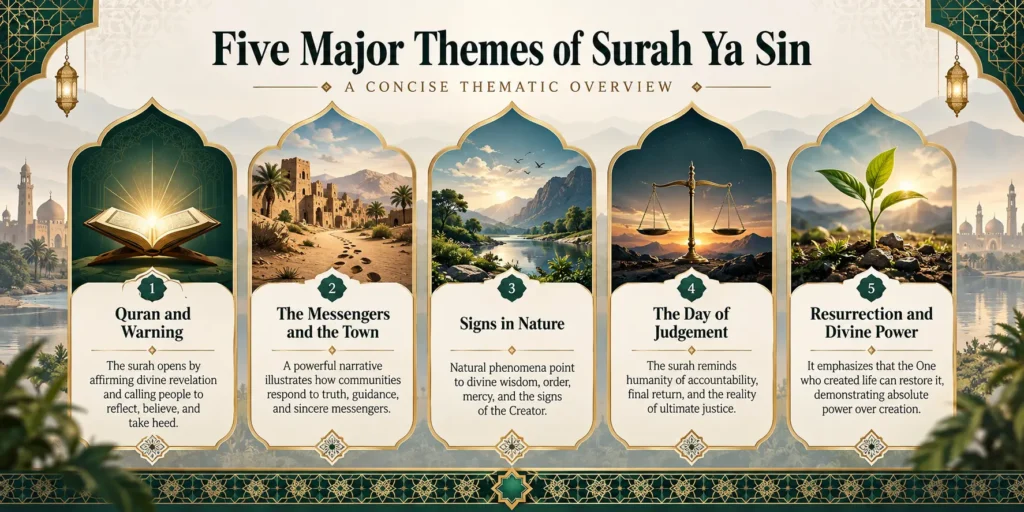
The surah moves in five stages:
- Verses 1–12 — The Quran, the Prophet’s mission, a warning to those who won’t believe, and God bringing the dead back to life
- Verses 13–32 — The story of a town and its messengers
- Verses 33–47 — Signs in nature, and people turning away from them
- Verses 48–68 — The Day of Judgement, Paradise, and the guilty
- Verses 69–83 — The Quran as a clear reminder, and the proof of resurrection
The longest story is the town and its messengers. Two messengers are rejected, so a third arrives to back them up. The townspeople call them liars and threaten to stone them. Then a man runs in from the far end of the city and urges everyone to follow the messengers. He’s told to enter Paradise, and he wishes his people knew. Muhsin Khan’s translation adds a note that the town is said to be Antioch, though the verses themselves call it only “the town.”
Next come the signs. Dead earth comes back to life and produces grain. Night strips away the day. The sun and moon each travel their own course. These verses answer a question the surah raises early on: if God can do all this, why would raising the dead be hard?
The judgement scenes are vivid. The Horn is blown and people rush from their graves. No soul is wronged that day. People in Paradise are happily occupied, while the guilty are told to stand apart. Their mouths are sealed, yet their hands speak and their feet bear witness.
The ending returns to the doubter who asks who could revive decayed bones. The reply is one of the most quoted verses in the Quran:
(82) إِنَّمَا أَمْرُهُۥٓ إِذَآ أَرَادَ شَيْـًٔا أَن يَقُولَ لَهُۥ كُن فَيَكُونُ
Innama amruhu idhaa araada shay’an an yaqoola lahu kun fayakoon.
“His command, when He intends a thing, is only that He says to it, ‘Be,’ and it is.”
This verse — often referred to as “Kun fa-yakun” — captures the surah’s closing point in one line: when God intends something, a single command brings it into being.

For deeper study, English editions of Ibn Kathir’s tafsir and Maududi’s Tafheem-ul-Quran are widely available through Quran reference sites and apps. Read the verses first, then the commentary, so the text speaks before anyone explains it.
Final Thoughts
Ya Sin rewards a slow first read. Take one sitting with a modern translation, let the arc of the surah settle, and only then return to the Arabic and the audio. Keep the virtue claims in proportion, too — the surah doesn’t need a famous phrase to earn your attention. Its message about the life to come is reason enough to understand what you’re reciting.
Frequently Asked Questions
Which part of the Quran is Surah Ya Sin in?
It sits across Juz 22 and 23. Juz 22 ends after verse 27, and the rest of the surah is in Juz 23.
Can I compare several English translations side by side?
Yes. Most major Quran reading platforms let you select more than one translation and display them together under each verse, so you can compare the options listed above directly.
Which reciters can I listen to?
Popular choices include Mishary Alafasy, Maher Al-Muaiqly, Abdul Basit, Saud Al-Shuraim, and Yasser Al-Dosari. Several Quran platforms also offer recitations paired with English translation on screen.
Is transliteration enough to read the surah?
It works as a guide, but it isn’t meant to replace Arabic. Reading the Quran purely from English letters isn’t considered ideal for recitation — use transliteration as a bridge while you build your Arabic reading skills.
Why is Ya Sin spelled in so many ways?
The name is a rendering of two Arabic letters into English, so spellings vary. You’ll see Ya-Sin, Yasin, Ya Sin, and Yaseen — they all mean chapter 36.

tahamehmood895@gmail.com
tahamehmood895@gmail.com shares helpful Quran learning, Tajweed and Islamic education guidance for Quran Learning UK readers.
Related Quran Learning Guides